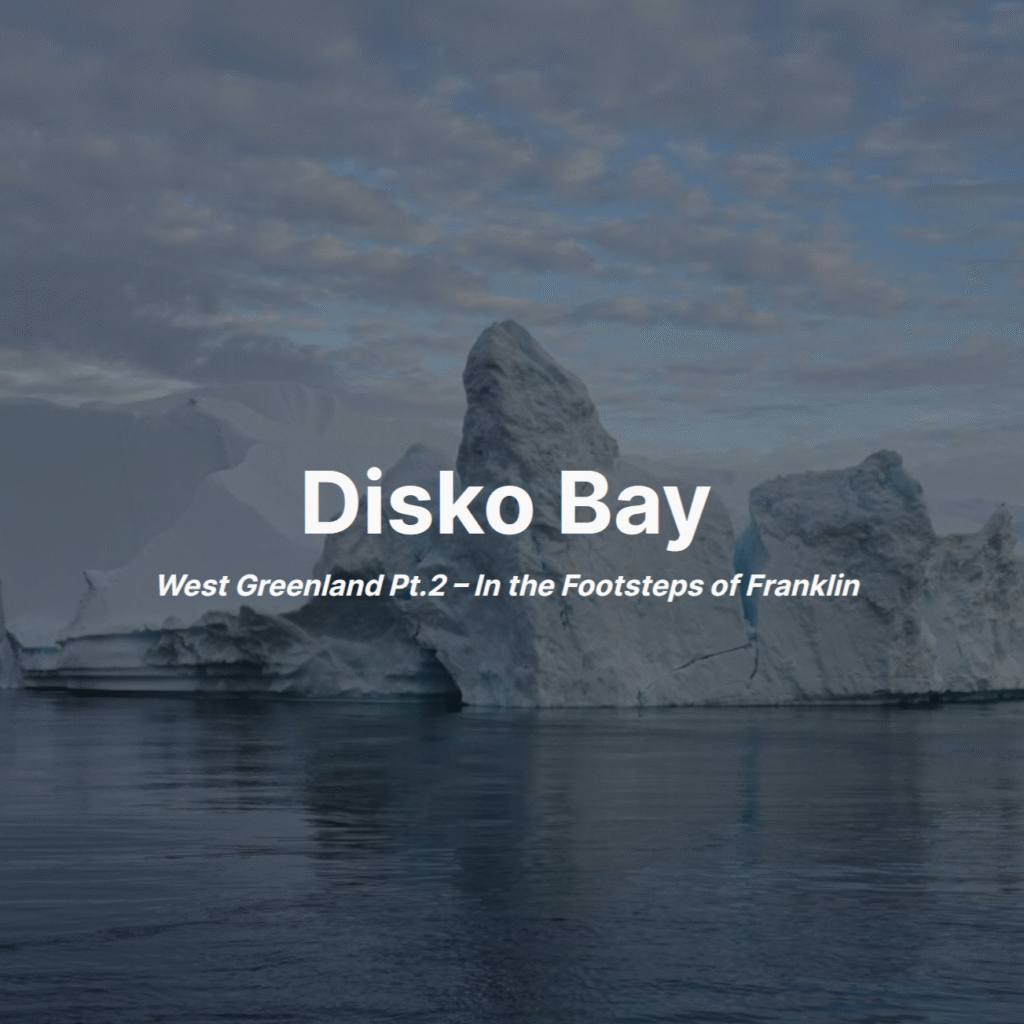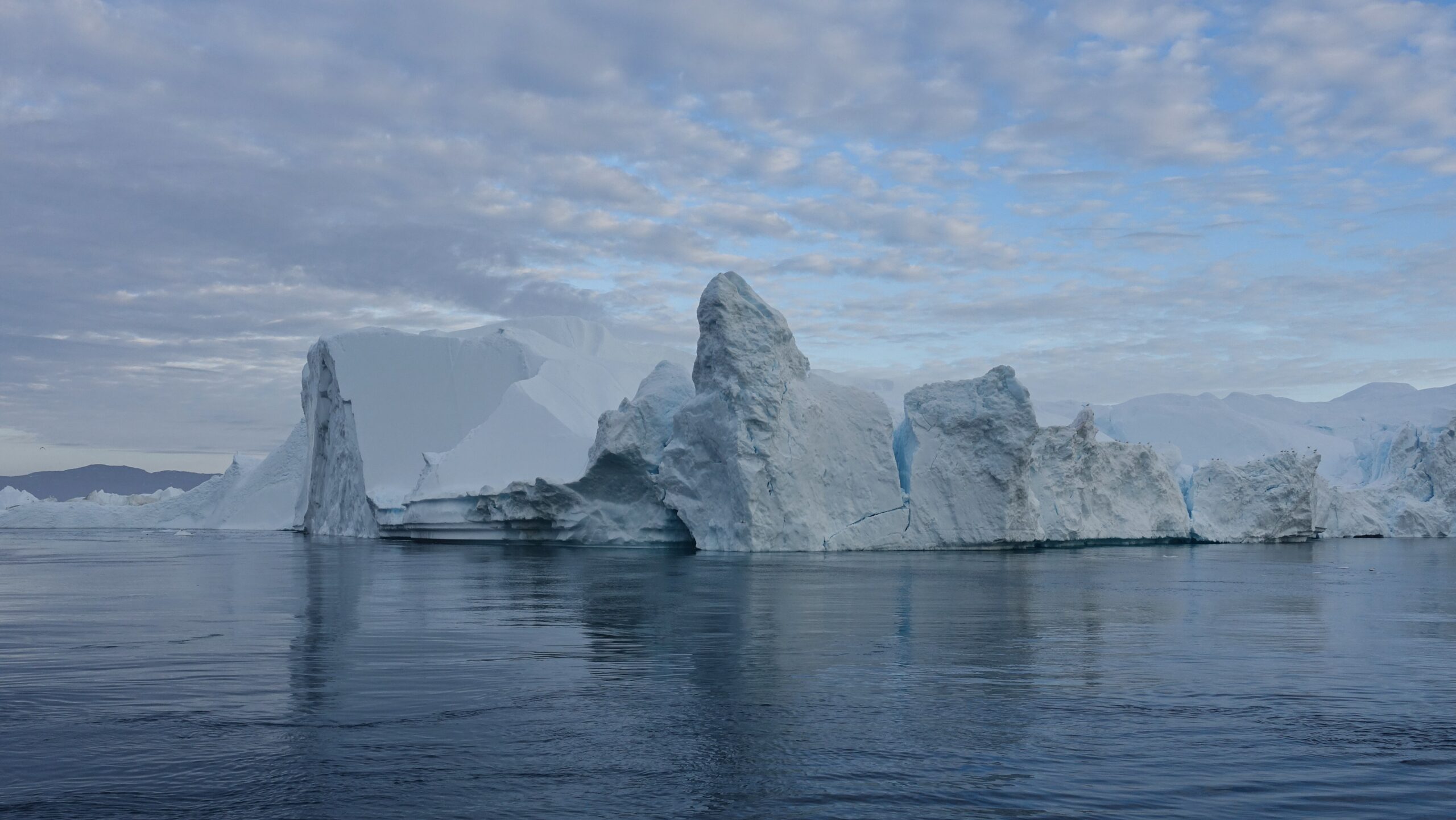
Disko Bay
West Greenland Pt.2 – In the Footsteps of Franklin
Introduction
18 July 2025 – 2 August 2025
Part 2 of the Greenland 2025 trip. Begin with Part 1: Nuuk.
Back in 2020, I had an exciting trip to Greenland booked with my mum. Unfortunately, everyone got a little authoritarian that year and the trip had to be cancelled. Five years later, it was finally time to revisit the trip!
Greenland has a lot to offer, with three, self-contained regions: West, South, and East. West Greenland is the most accessible and contains the capital Nuuk, the Arctic Circle Trail, and Disko Bay. South Greenland has the magnificent Tasermuit Fjord and historic Viking settlements. East Greenland is almost uninhabited, with really only one small settlement but holds incredible mountaineering possibilities. Each region is fully deserving of attention, but with poor transit connections between regions, it is really only possible to do one in a single trip. With the culture of Nuuk and Ilulissat’s icebergs, West Greenland was the obvious starting point.
Because we already had a fully formed plan from the 2020 trip, a lot of the legwork had already been done. But a new year meant a fresh chance to revisit things.
During planning, Disko Bay was always considered a must for any first trip to Greenland. Being well connected (by Greenlandic standards), and home to both the Ilulissat Icefjord – the icefjord that sank the Titanic – and the one of a kind, Disko Island.
The centerpiece of the region is the fast moving Jakobshavn Glacier, flowing at nearly 45m per day and accelerating (for comparison, the Khumbu Icefall flows at about 1m per day, and is considered fast). It is the most productive glacier in the Northern hemisphere. This glacial activity supports extremely rich waters that have been always been central to human populations in Greenland. And having been studied for over 250 years, it is of significant scientific interest – particularly with respect to climate change.
Arrival
Friday, 25 July
The plan back in 2020 was to take the ferry from Nuuk to Ilulissat. There is just one boat, operating a single line from Ilulissat to Qaqortoq so the timetable does not leave room for flexibility, this was actually the final nail for the 2020 trip. This time we opted to fly both directions, [theoretically] saving time and hassle, all for the same price.
Greenland is on something of an infrastructure kick and like Nuuk, transport changes are coming to Ilulissat. In fact, the settlement is getting a whole new airport with a runway long enough to handle widebodies. That is a frightening thought given that Tuukkaq (Air Greenland’s A330) carries 10% of Ilulissat’s entire population. The new airport was due to open last year but is delayed and still not open.
The theme of needlessly stressful flight difficulties that began with the inbound international flights was set to continue. We were stuck at Nuuk Airport for an eternity as the flight was continuously pushed back for unknown reasons. Eventually, we were able to board. The relief of finally being on our way and excitement of a spectacular climb out was cut short by an announcement that we were immediately returning to base due to an electrical fault… And thus began a new waiting game!
Fortunately, there was space for everyone on the next Ilulissat flight and this one took off almost on time. Though not without the final drama of an incorrect boarding announcement and gate name (the wrong settlement called/listed and the departure board was shut off), nearly resulting in us missing boarding. Once we were finally on our way, views of mountains, fjords, and the icecap were absolutely spectacular as we were shadowed by a Brocken Spectre all the way north. On final approach into Ilulissat, the aerial views of the Icefjord were incredible.
Problems persisted on arrival at the AirBnB. Most concerning was a complete lack of running water – something that was definitely not listed in the description. I’ve never encountered anything like that before – there is nothing wrong with basic accommodation, but it needs to be mentioned and not having water was going to be a significant complication. Hungry and not happy, I set off for a first glimpse of the icefjord.
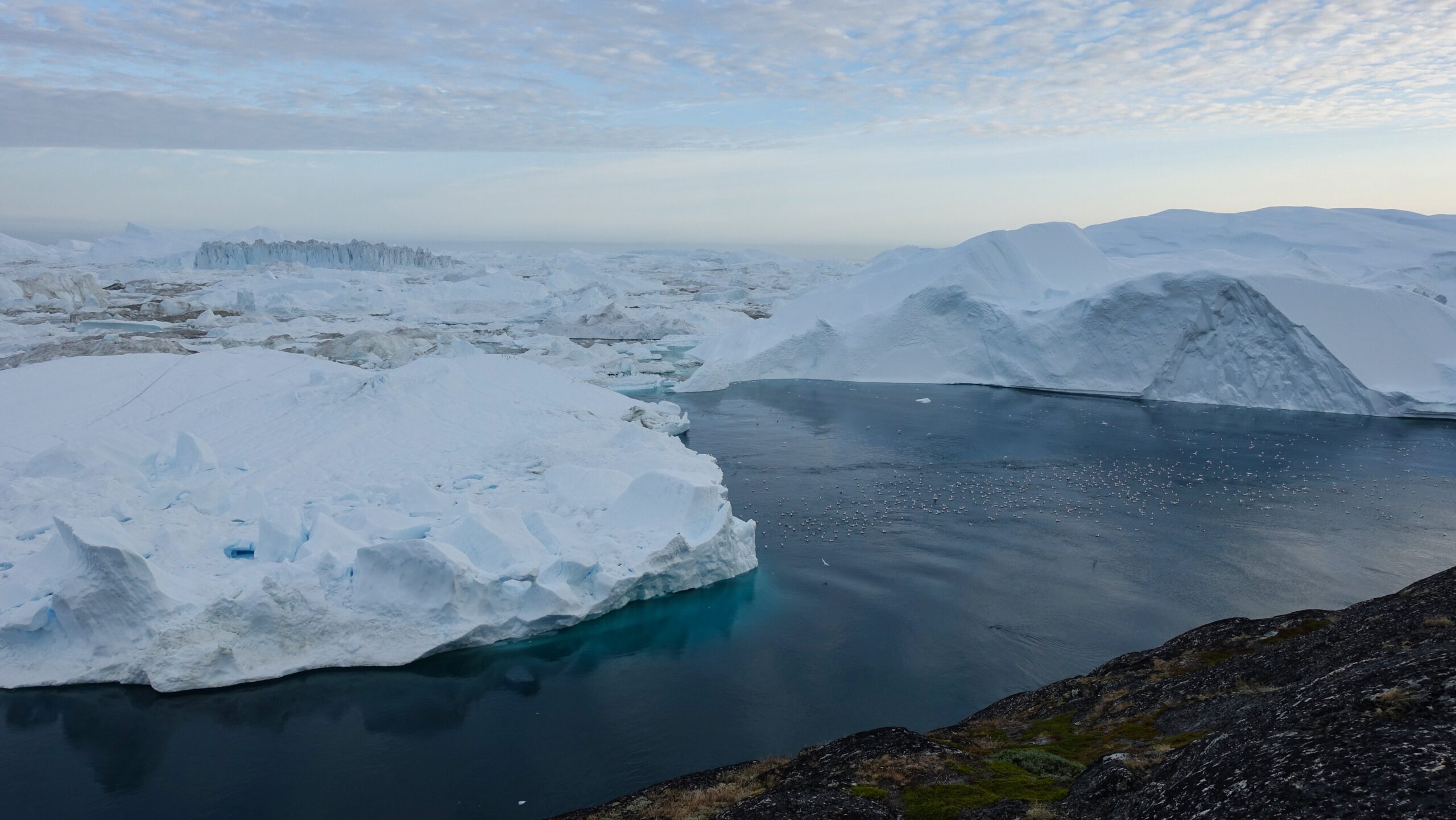
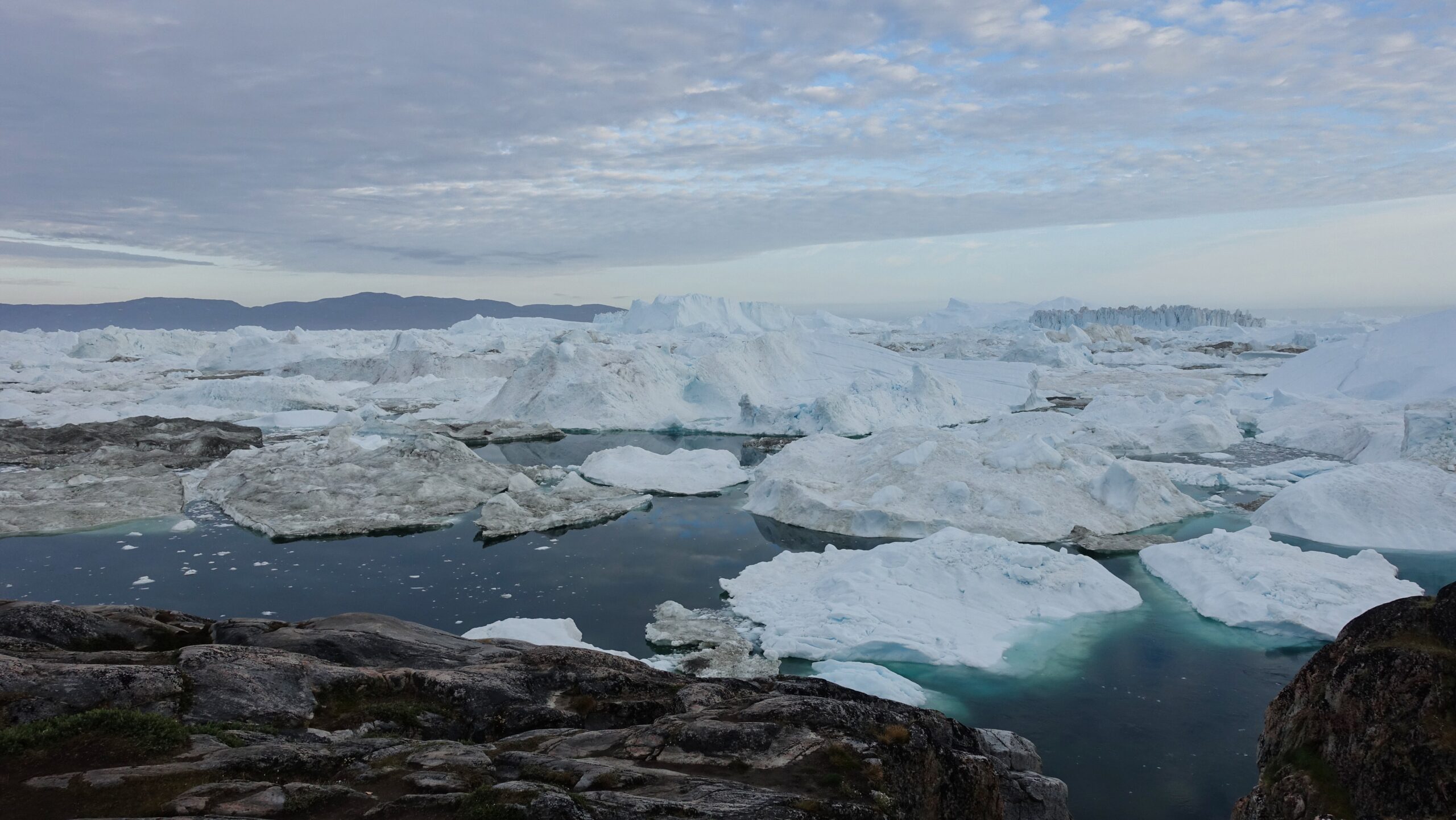
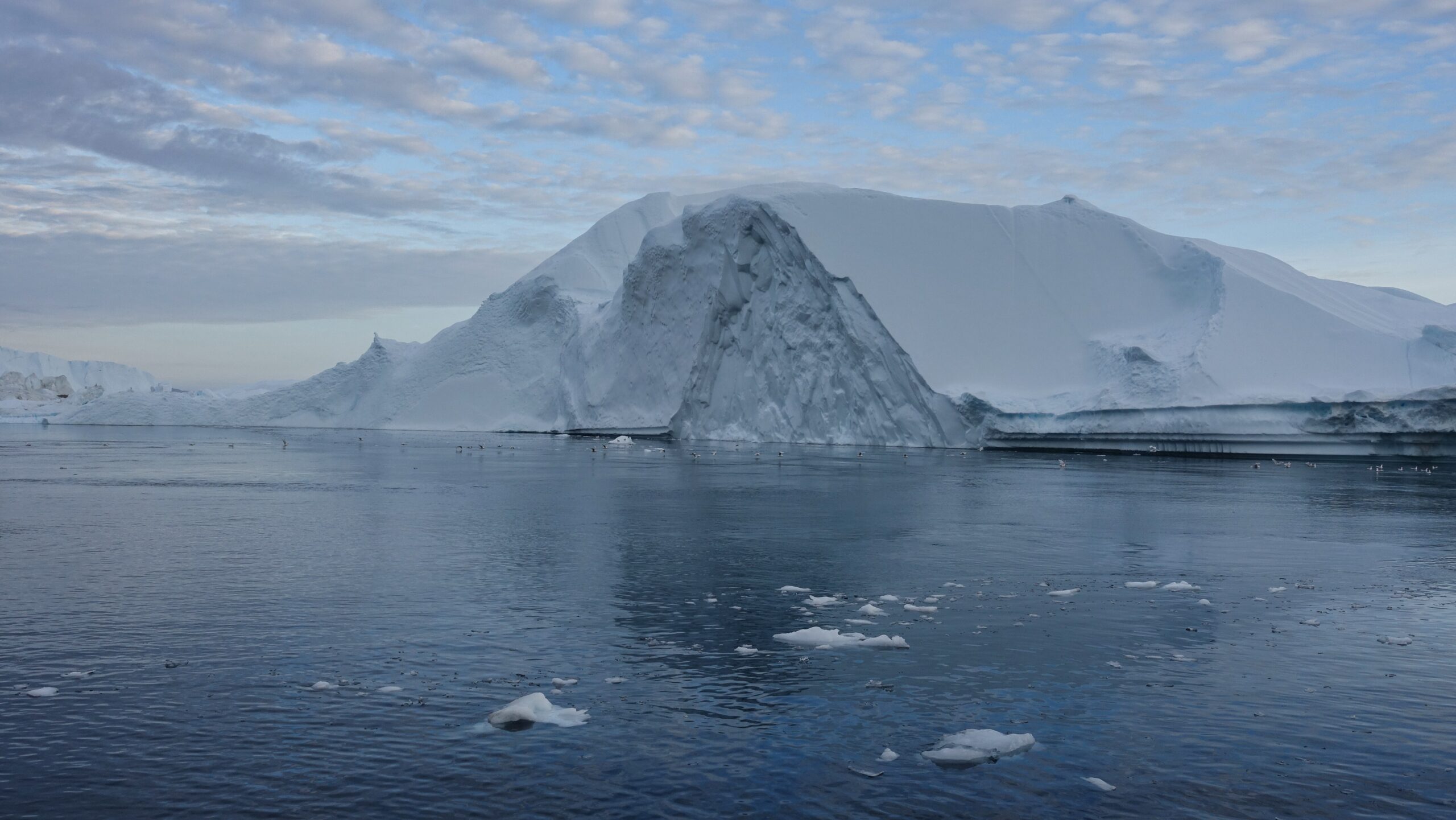
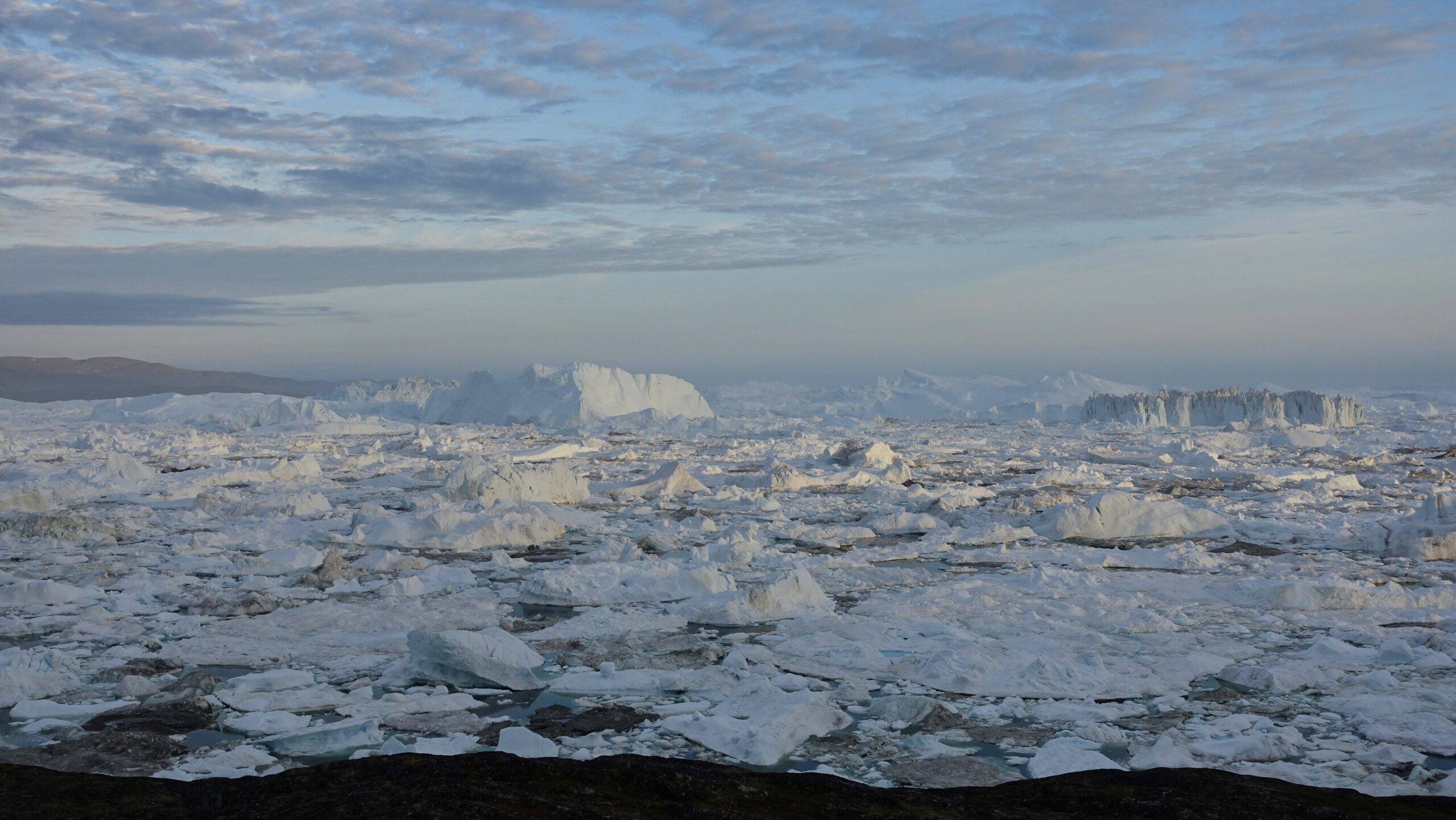
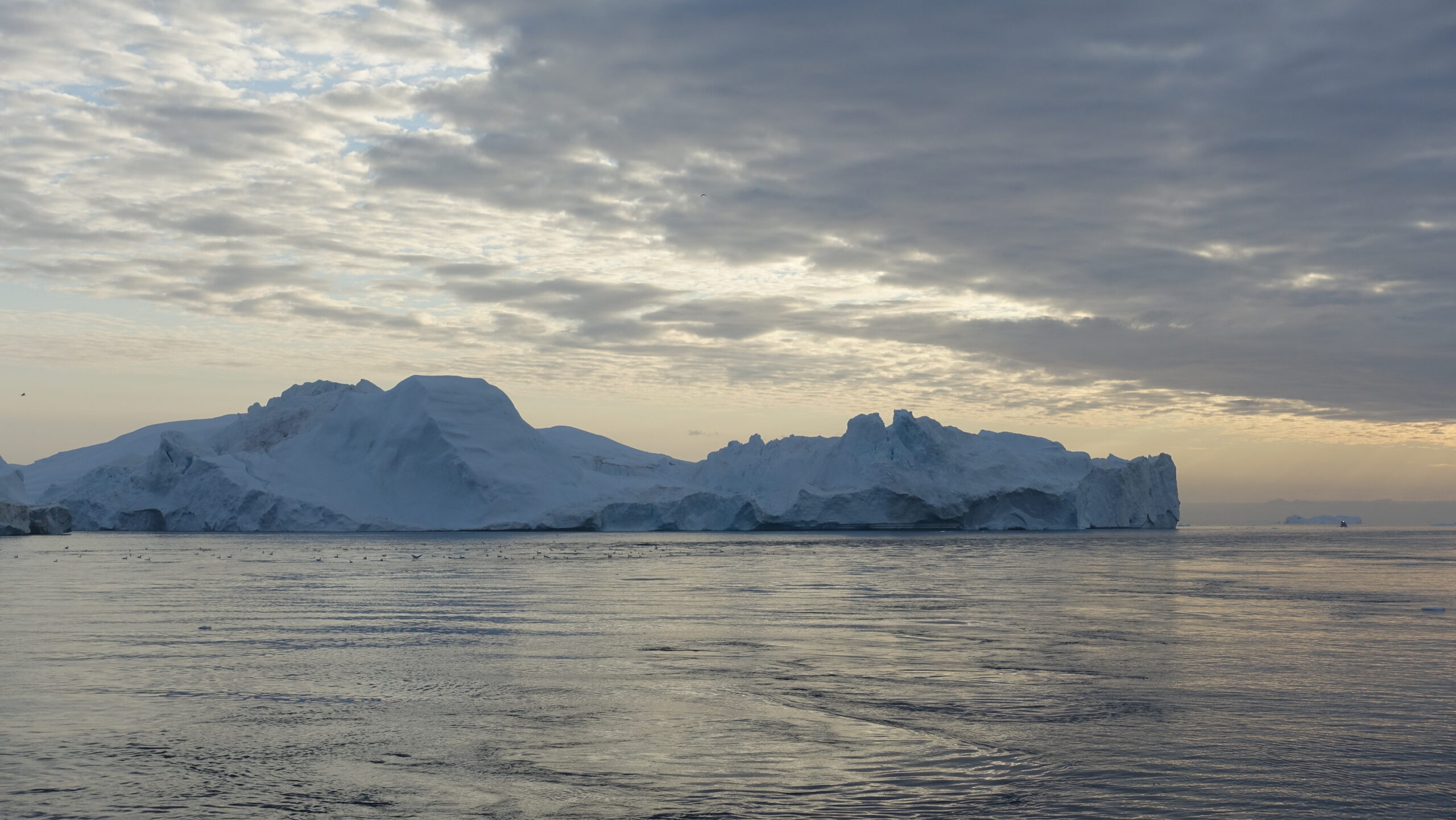
Disko Icefjord
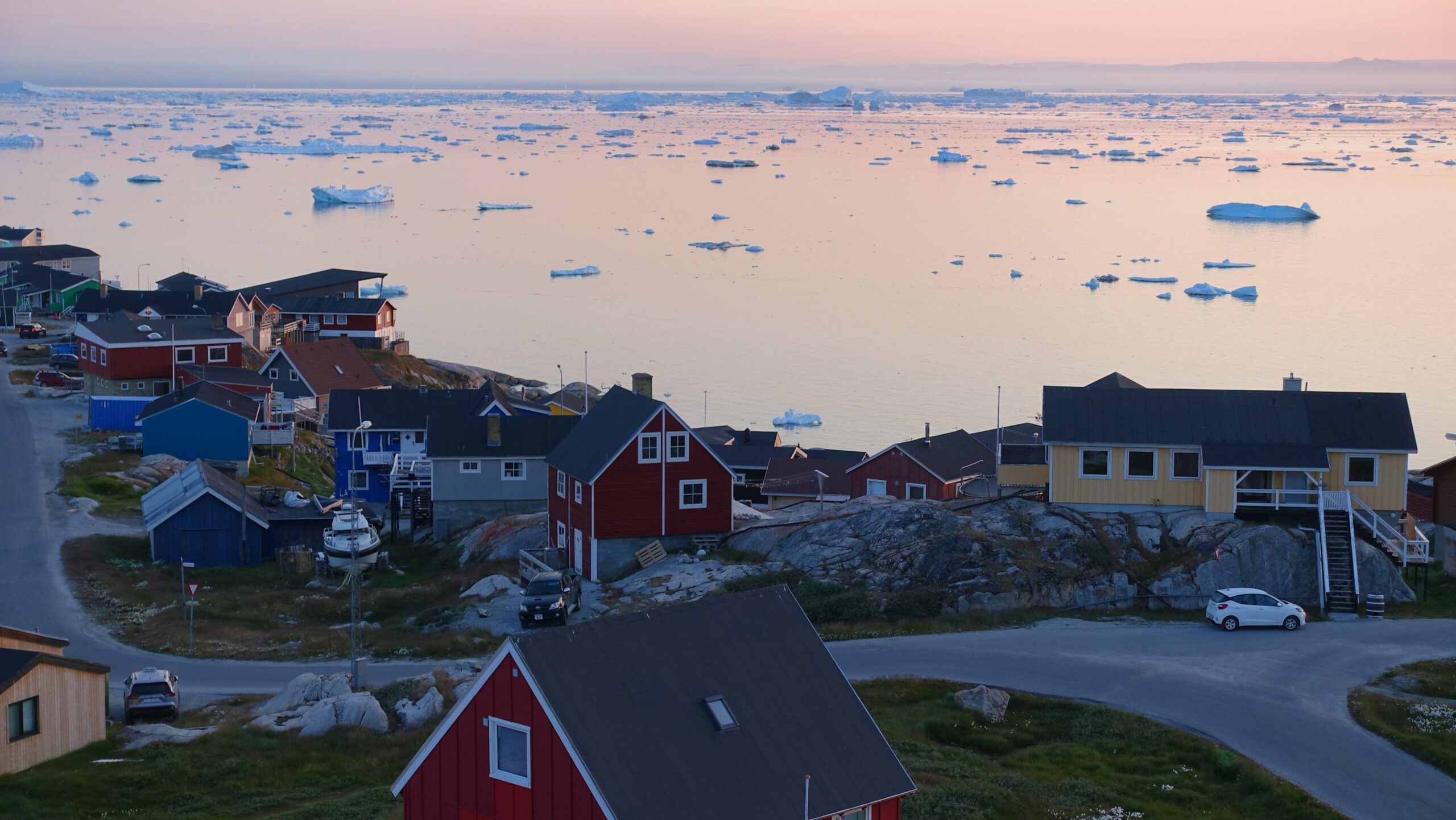
Without a plan, I made my way to the closest of three short circuits along the northern shore of the icefjord. After linking with the World Heritage Trail, a boardwalked section of trail along Sermermiut, an area of paleo-eskimo settlement, I reached a rocky outcrop that promised more interesting views. Some easy bouldering led me to a particularly special view. In addition to a unique perspective of the icefront, the narrow stretch of open fjord was absolutely swarming of sealife. There was an enormous colony of seabirds feeding and I even got a glimpse of a seal hunting.
I managed to time the walk nearly perfectly and was very glad that I went out as I was far from convinced that I would have good conditions for the remainder of the week. I was hoping I hadn’t frontloaded the time on the icefjord too much.
Exploring Ilulissat
Saturday, 26 July
Heavy fog was predicted for most of the time in Ilulissat. Fortunately, I had learned in Nuuk that Greenlandic weather predictions are terrible and the fog forecasts particularly unreliable. Sure enough, I woke to clear but hazy skies.
It made the most sense to go out in the late evening. For one, despite temperatures being around 10 degrees, it felt uncomfortably warm under the direct Arctic sun. But also the sun’s intensity and positioning meant that views of the icefjord would be completely washed out for most of the daytime. I didn’t want to waste the day entirely though, so got out for a few hours to explore the town in midmorning before getting some food shopping in.
Unsurprisingly, food options were considerably more limited in Ilulissat. I had been very impressed by the excellent selection in the capital. Staples were an odd assortment of different Nordic supermarket brand names. Interestingly, but not entirely surprising, food options in Ilulissat seemed to vary as they ran out of stock. One product would give way to a massive gap on the shelves before being replaced by an equivalent but entirely different product. Fresh meat and fish was the thing that there was absolutely no shortage of. In the case of meat, there were a number of interesting cuts. I would have been tempted, but I wouldn’t know what to do with them.
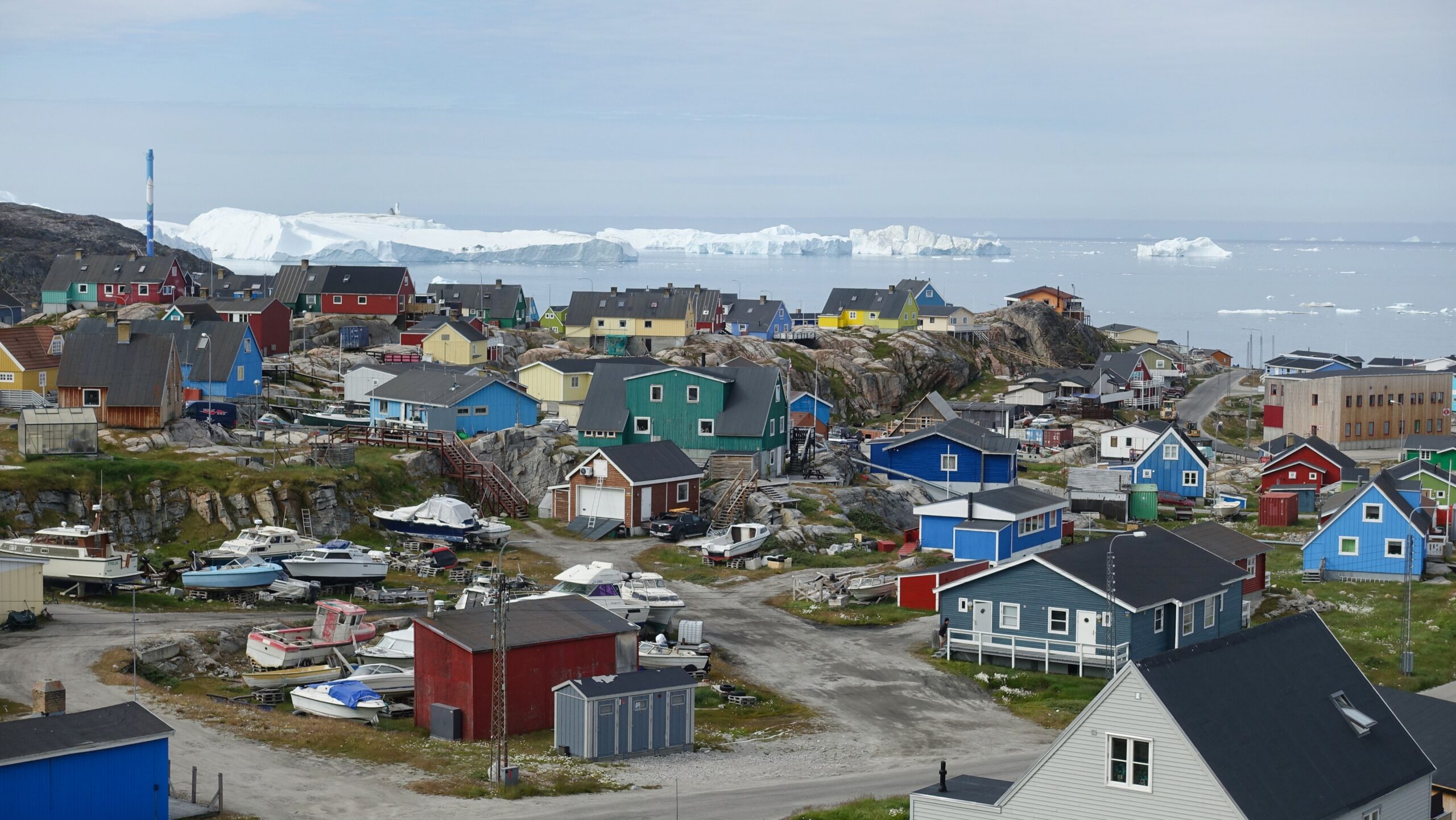
The AirBnB is under the orange house on centre-right
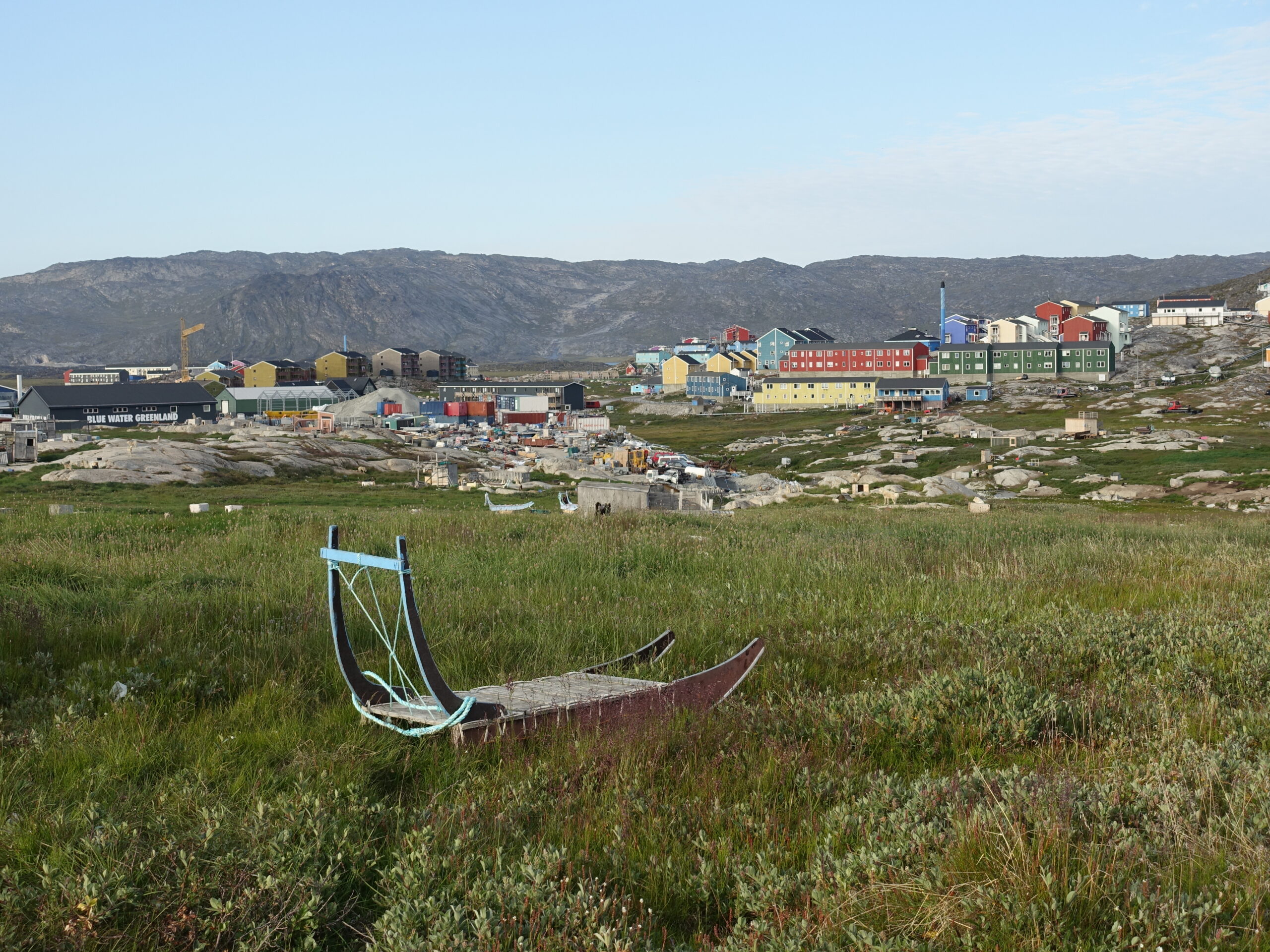
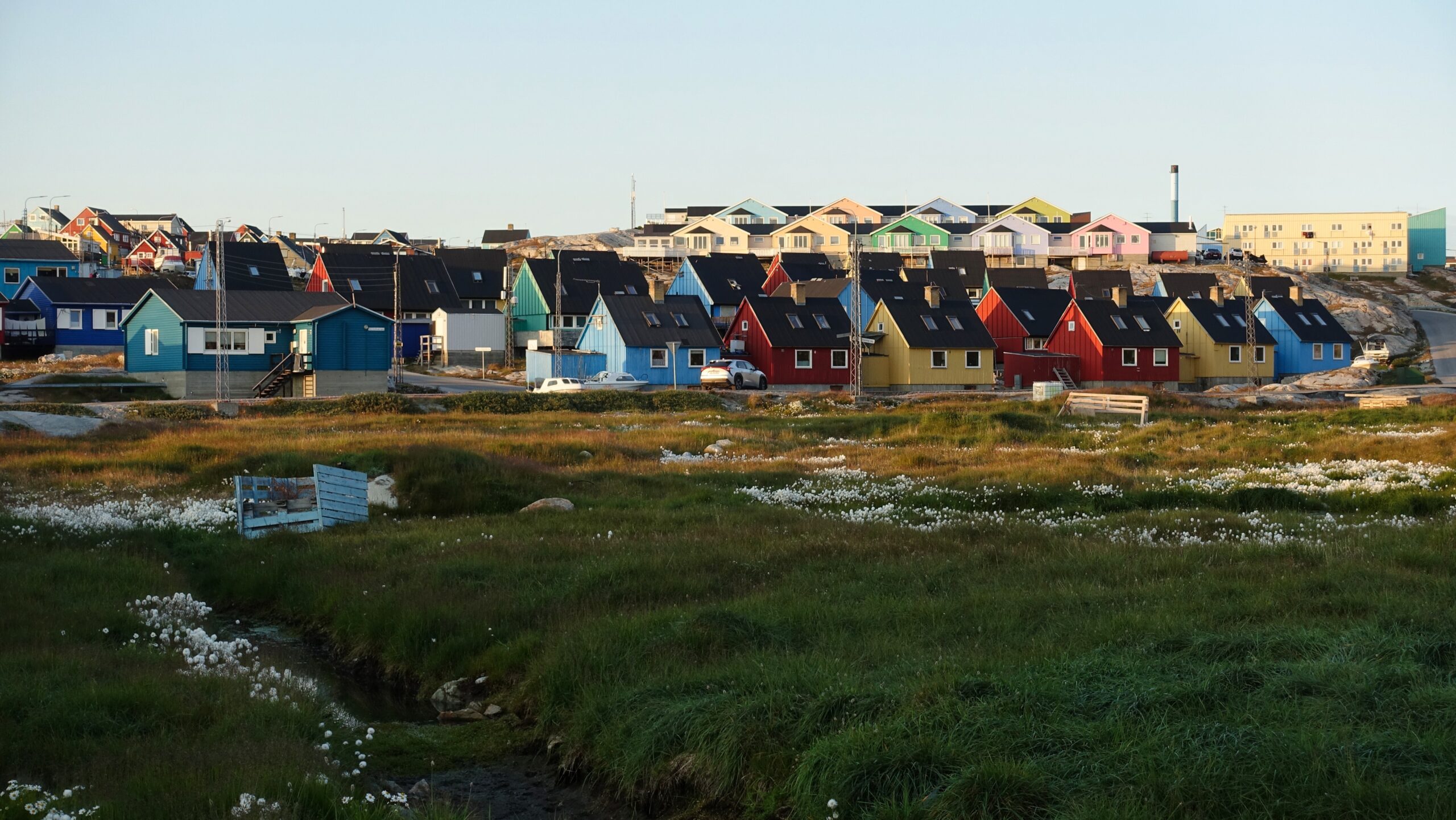
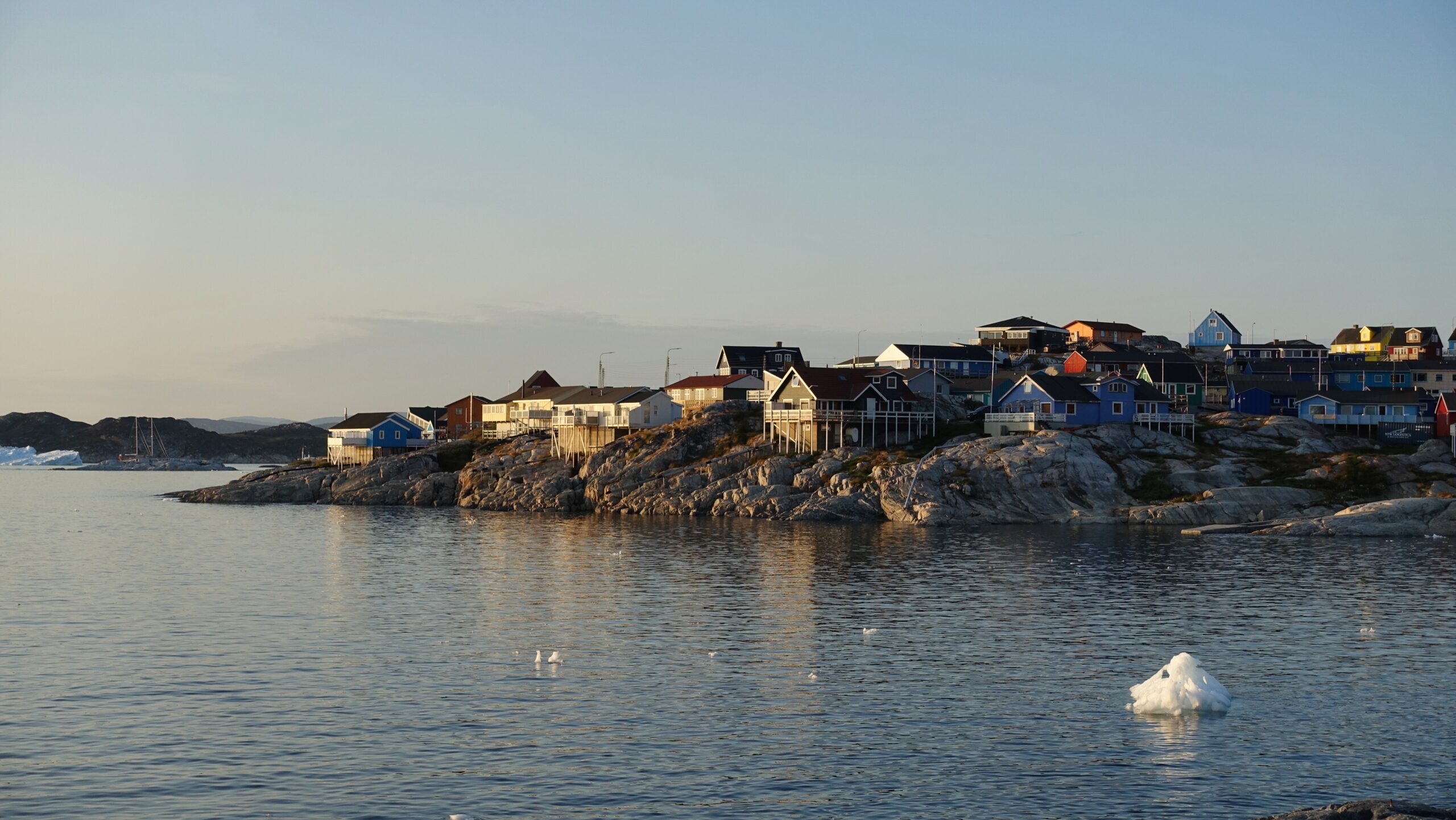
Different sides to Ilulissat
The next day I had an ealy departure for a two day trip to Disko Island, so I took the afternoon to pack and make final preparations.
By evening, the haze had lifted and it was back to the icefjord. I took a different rout this time, starting from the Icefjord Centre and tracking southeast to Seqinniarfik, then following the coast. Knowing I had an early start the next morning and two long days out in the wild, I did not want to stay out too late – I returned at about 23:00.
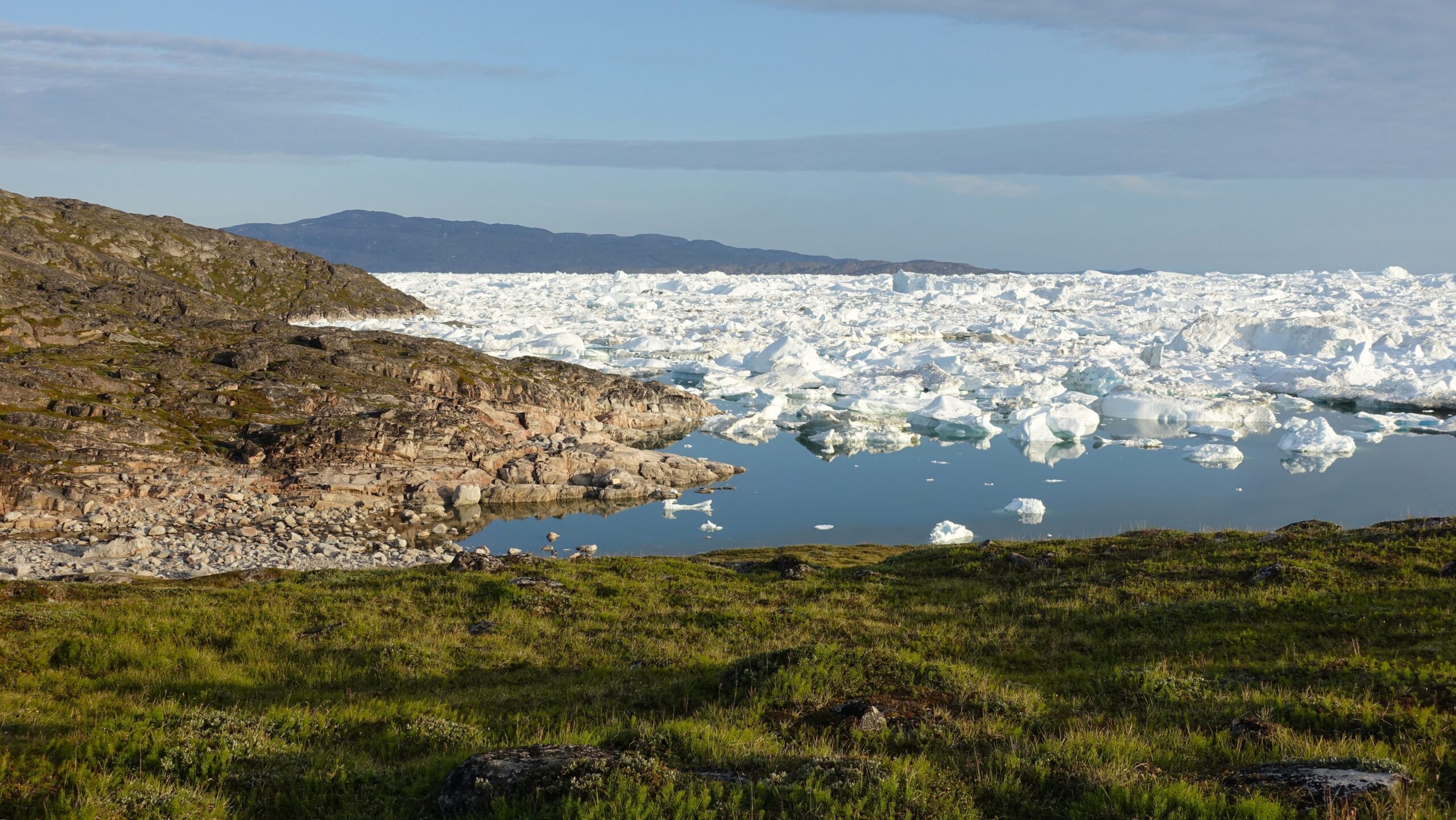

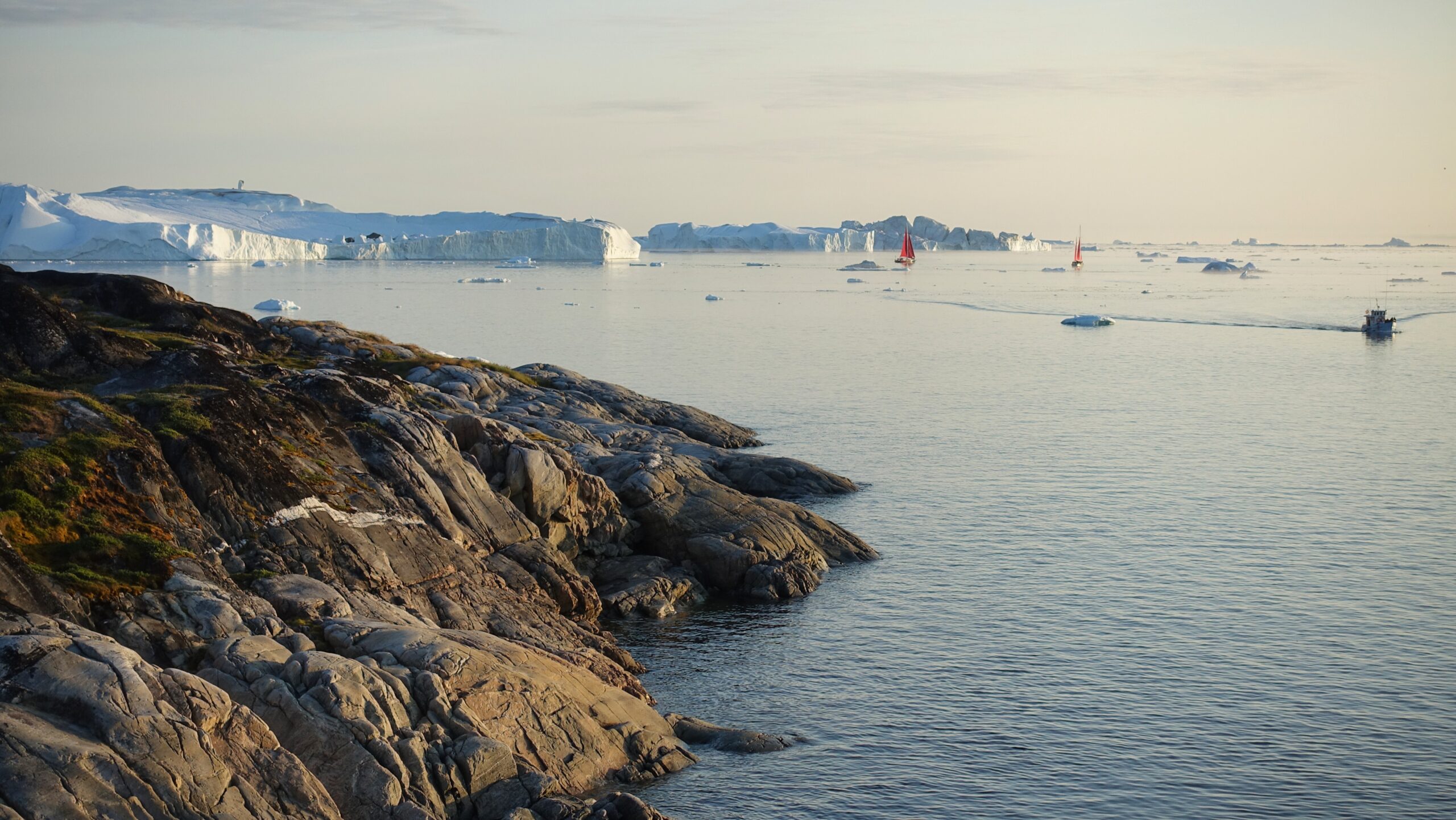
Another splendid evening on the Icefjord
Disko Island (Qeqertarsuaq)
Sunday, 27 July – Monday 28 July
Disko Island (Qeqertarsuaq, or Large Island), is geologically unique and has held cultural significance since the era of Eric the Red. Unlike the rest of Greenland, it is volcanic and the landscape therefore deviates heavily from the mainland, featuring high table mountains, black sand beaches, and basalt rock formations. The modern settlement Qeqertarsuaq (also named Qeqertarsuaq, and formerly Godhavn), grew out of the whaling industry to be Greenland’s second city and administrative centre for the North until 1940 when control was centralised in Godthab (now Nuuk). Interestingly, it is also the only place in the world with large deposits of native iron (non-meteoric and found naturally in metallic form). The knives made by local Inuit are therefore entirely unique.
The original plan in 2020 was to spend several days on Disko. I was planning to do a three day circuit of Blæsedalen (Itinneq Kangilleq) and Brededal (Kangikerlaap Itinnera). This was always rather ambitious planning, given the untamed terrain and high potential for poor weather. When replanning, I was still very interested in the destination but was hesitant to commit either to such a questionable timeframe or to add more days to the trip. It was therefore decided to eliminate Disko, but leave enough time in Ilulissat to allow the option open for an overnight excursion.
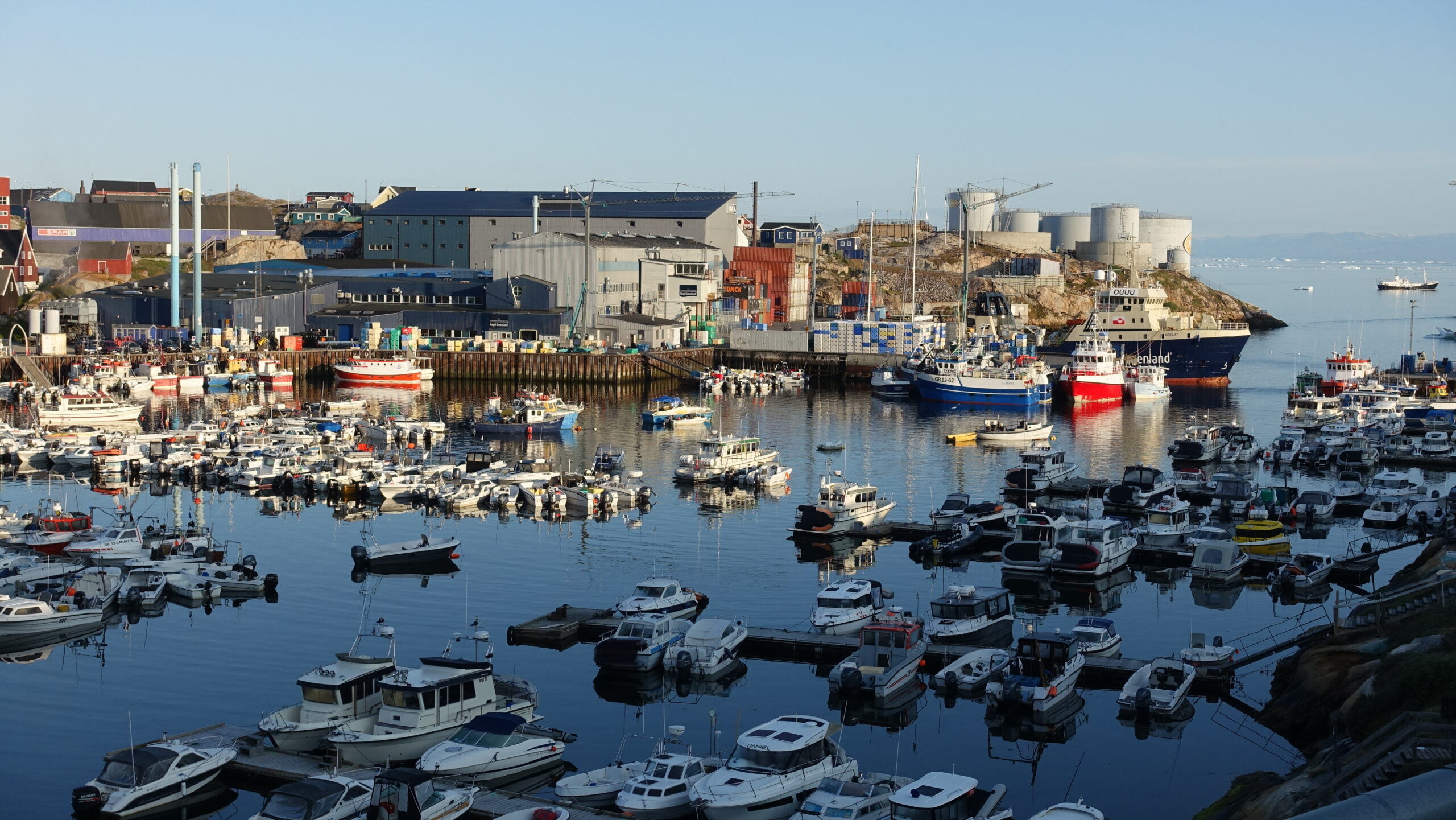
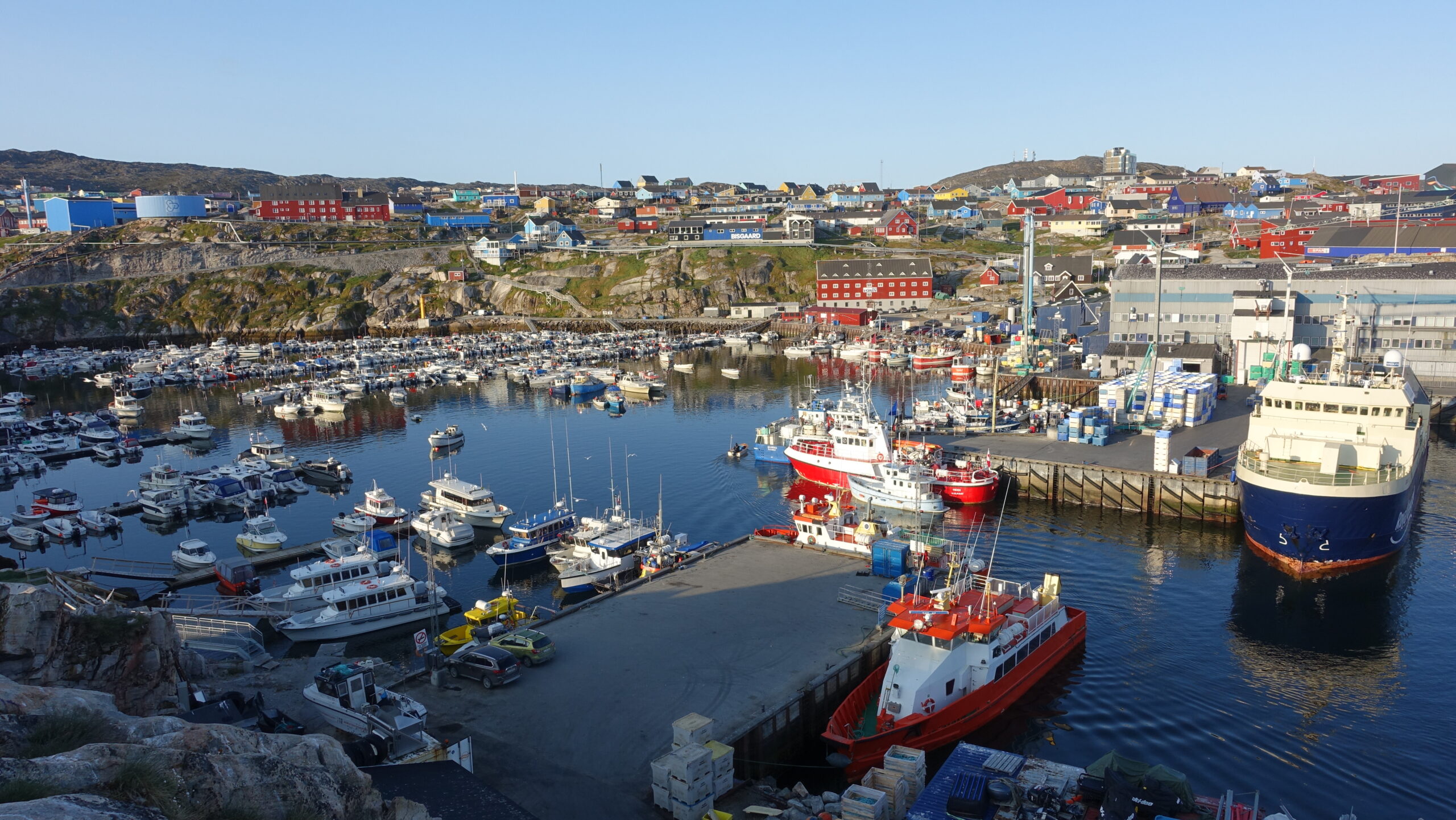
Morning on Ilulissat’s busy harbour
I was departing on an 8:00 ferry, but it was a thirty-minute walk to the pier and passengers are supposed to arrive thirty minutes early. The ferry is a very small boat (10-seat motorboat), a little surprising given the two-hour crossing of open sea. It is no surprise that they frequently have to adjust the schedule due to difficult conditions. Because all three passengers had arrived, we departed thirty minutes early, immediately after the other morning departure, scheduled for 7:30.
With some foreshadowing and as a testament to how sleep-deprived I was, I unknowingly drifted to sleep despite the choppy journey.
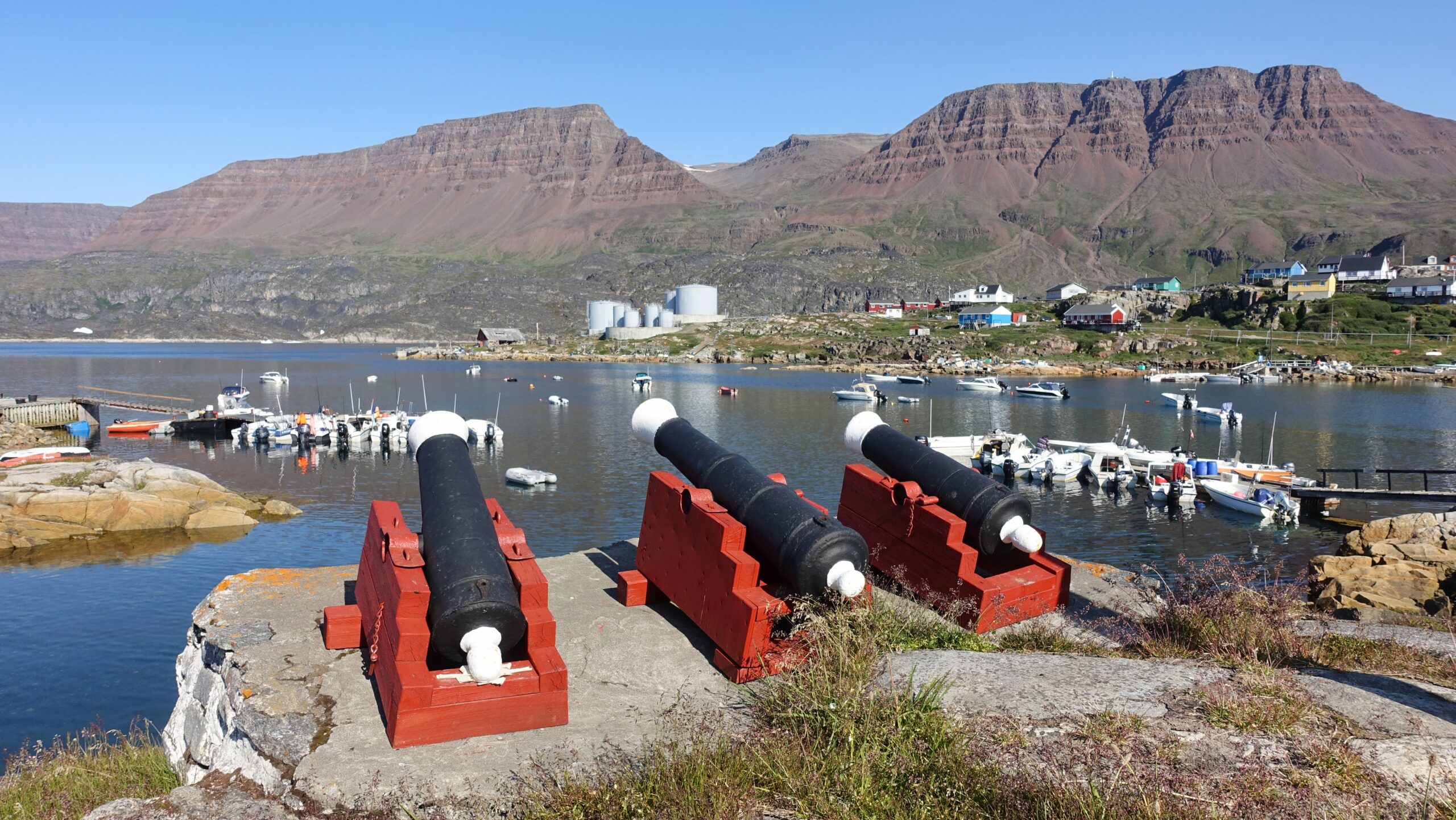
Qeqertarsuaq harbour
I started with a quick exploration of town on my way to the old whale watching hut at the end of the peninsula where I are lunch. It is quite a colourful and pleasant village with a stunning location.
On my way out of town, I was keen to check out Qeqertarsuaq’s little ‘stadium’ on the beach. Arguably the most stunning football pitch in the world, it is flanked by a small black sand bay holding stranded icebergs and massive red table mountains.
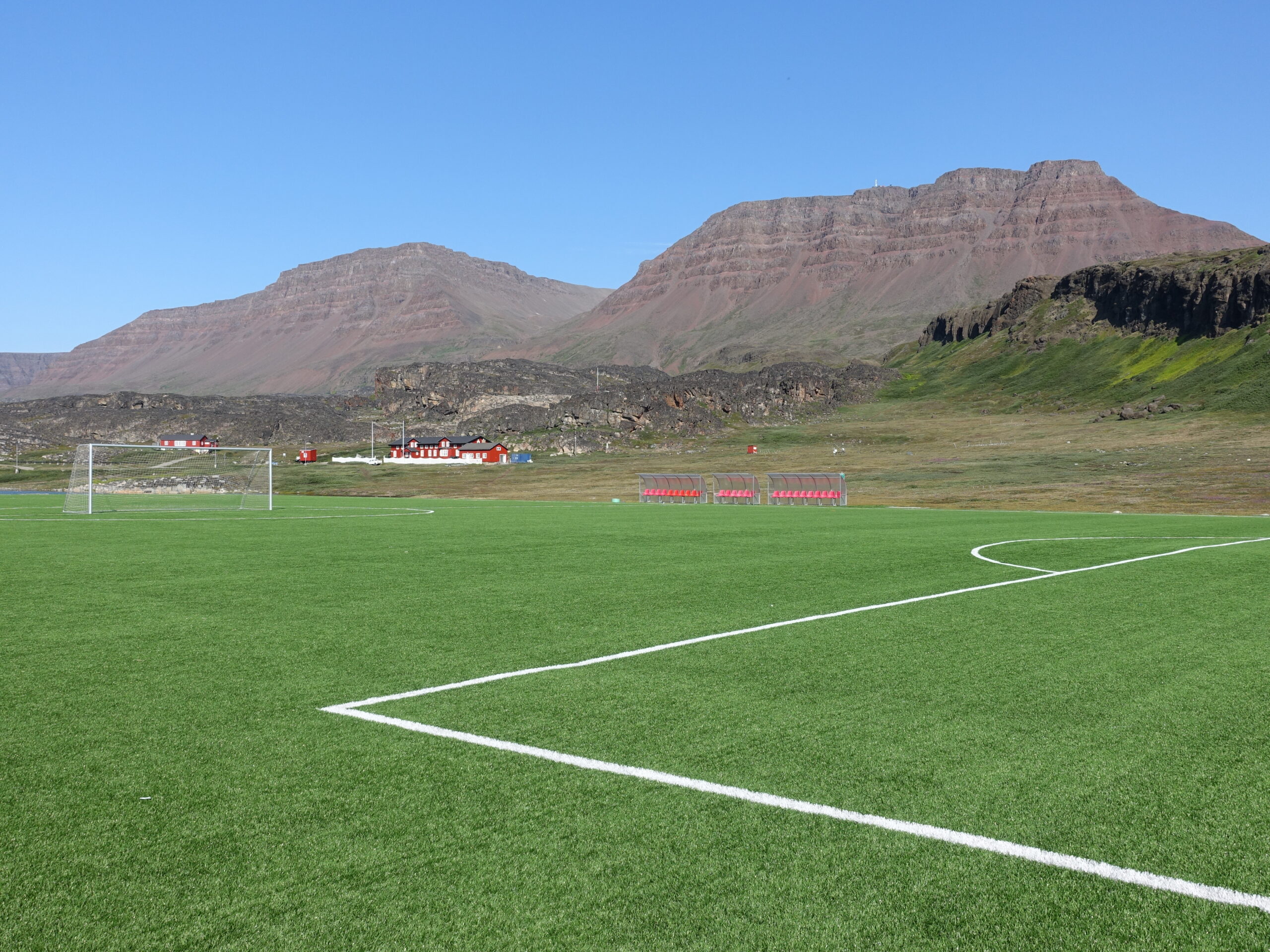

But can he do it on a cold night in the Arctic as the icebergs watch on?
As I made my way up Blæsedalen, I quickly reached a waterfall on Røde Elv where the ‘trail’ ended and the adventure should have begun. Unfortunately, I was massively struggling energywise. I was behind on sleep. A perpetual problem predating the trip resulting from the cacophony of Dutch living, but not helped by wanting to capitalise on hiking in the soft lighting of the late-night Arctic sun, and exacerbated by the difficult Ilulissat accommodation.
I continued to push on, slowing ever more as I was simultaneously increasingly bothered by the swarming mosquitos. Eventually I reached a rise that made for a perfect camp/rest spot. It was well short of my intended camping region, but it was hard to ignore how perfect it was.
I wanted to stop for a nap and maybe a reading break before continuing. I knew that if I did that in the open there wouldn’t be anything left of me though. Similarly, I knew that if I set up the tent to avoid the mosquitos, I would be unlikely to want to take it down and continue later in the day. After some back and forth, I opted to make camp, have a nap, and reassess in the evening. I could leave the sleeping gear and head out for day hikes that evening and next morning, hopefully refreshed.
Three hours later I woke up… It didn’t make sense to buy gas for just a single night in the backcountry, so dinner was cold baked beans and canned tuna on bread.
In the evening I decided to try to ascend an unnamed top above a glacier near my camp – it was marked as a ‘recommended route’ on my map. I was still exhausted, and the mosquitoes were as bad as ever. But I would have regretted not trying. I crossed the unpleasant lower moraines, but at the base of the glacier I couldn’t see a good way to progress. the map had indicated (very roughly) that I should ascend next to the glacier, but that did not look like a fun time. Assaulting the glacier directly looked the best choice, but I didn’t bring crampons and left my axe in Ilulissat. After milling about for a time, I decided attempting to recover well overnight and have a fresh start in the morning was an easy sell. Maybe a good route up the side would have appeared if I had progressed, but honestly, I was primed to accept the turnaround decision.
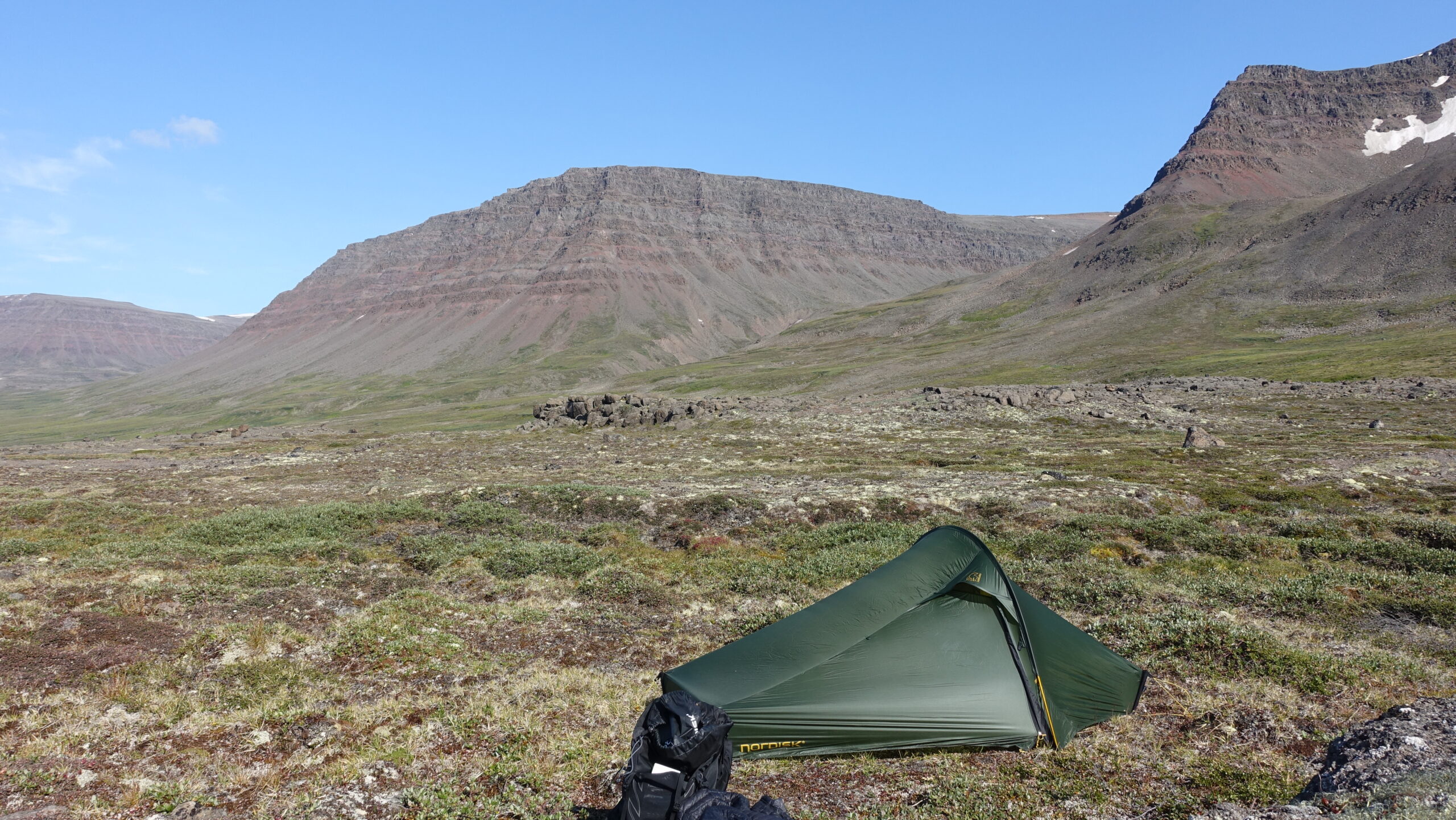
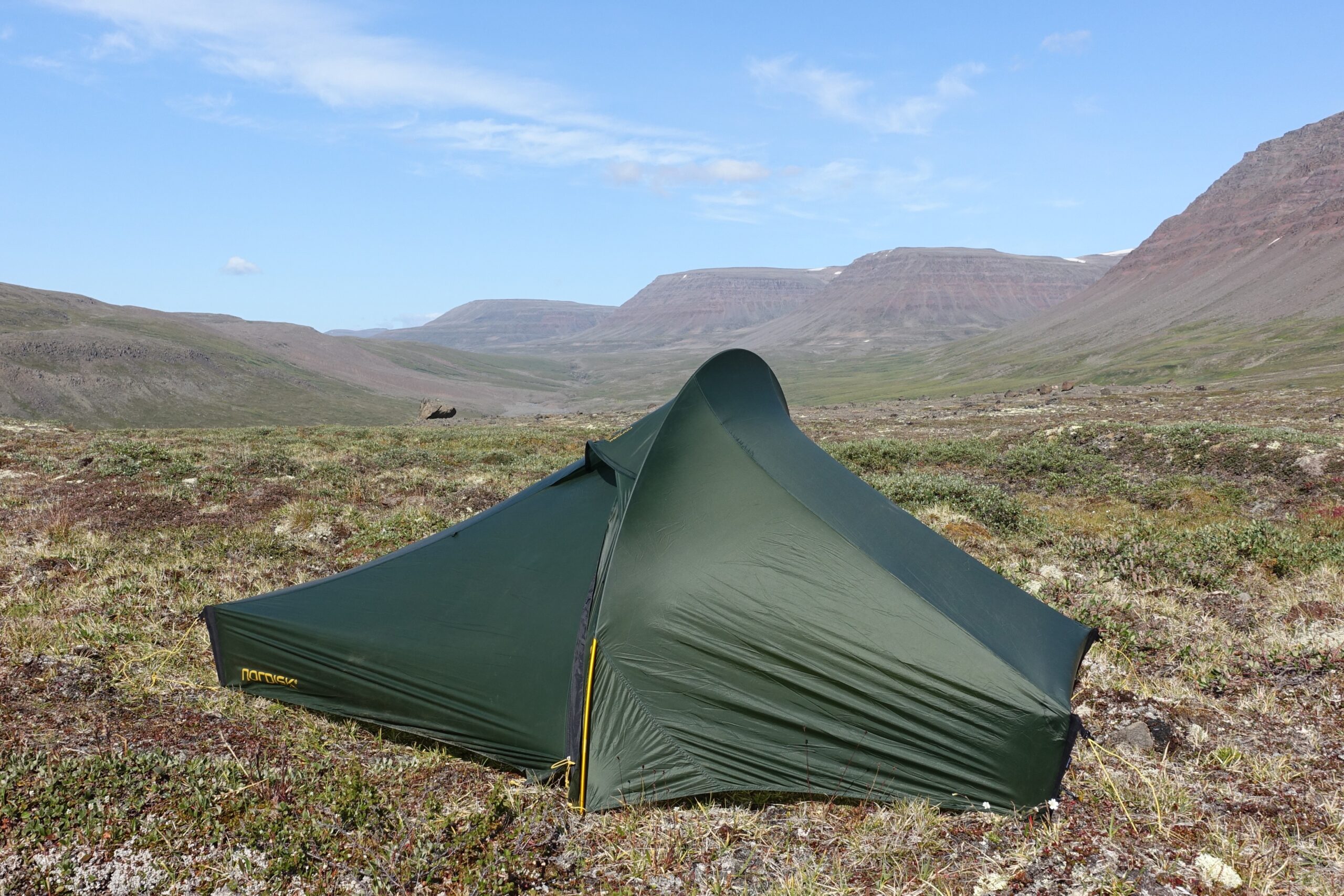
Never have I had a better campsite! Water was a trek though
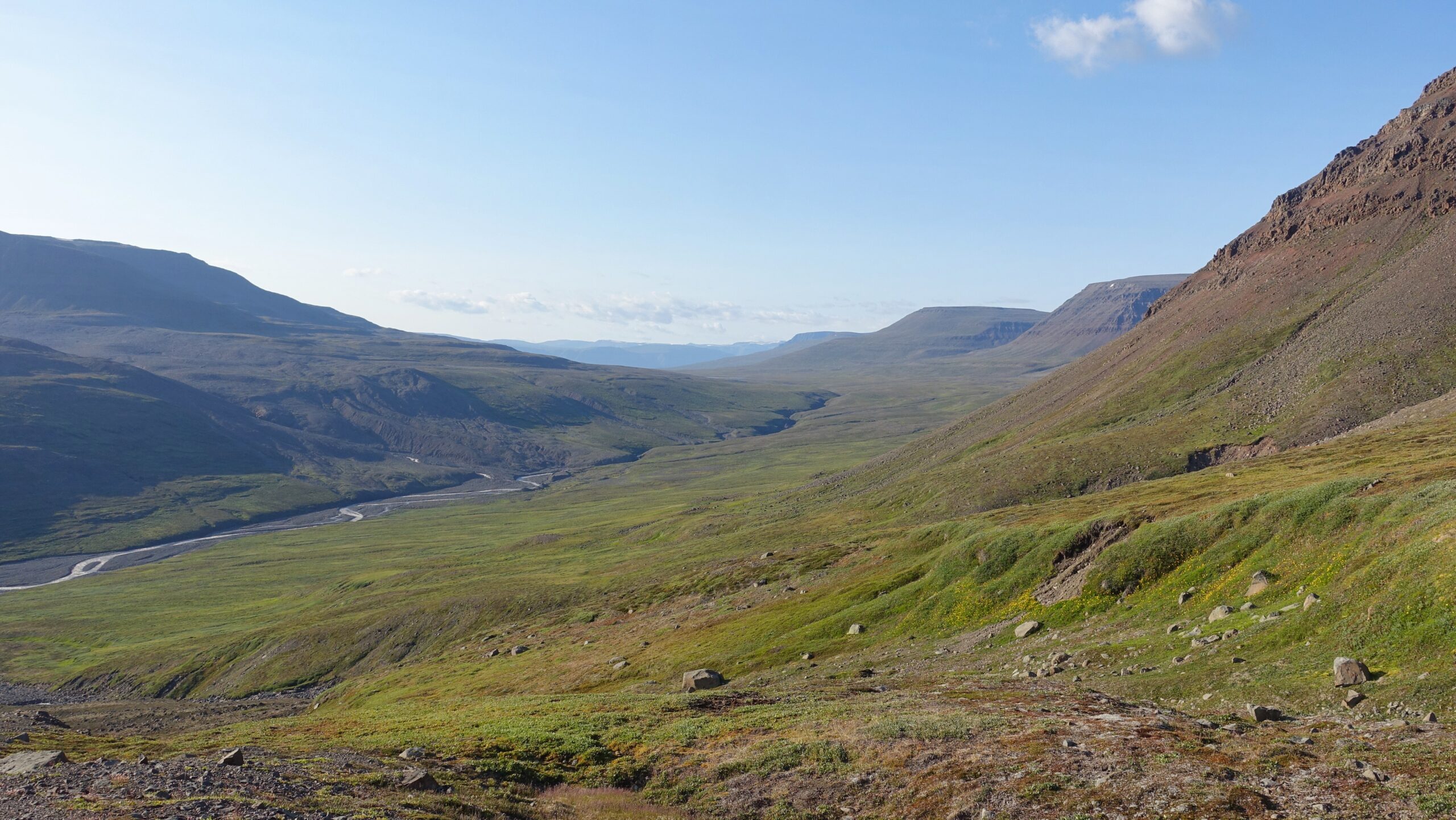
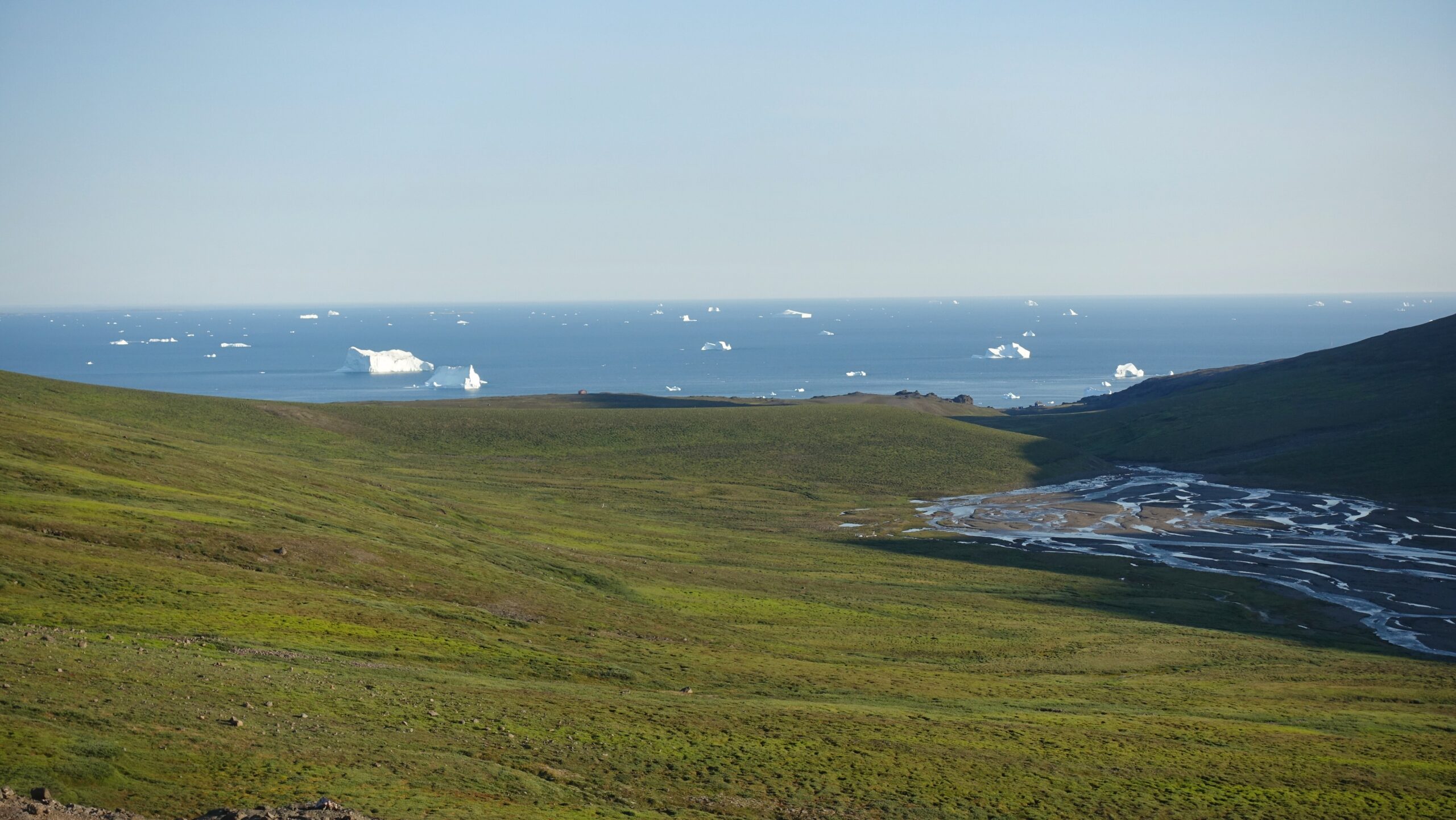
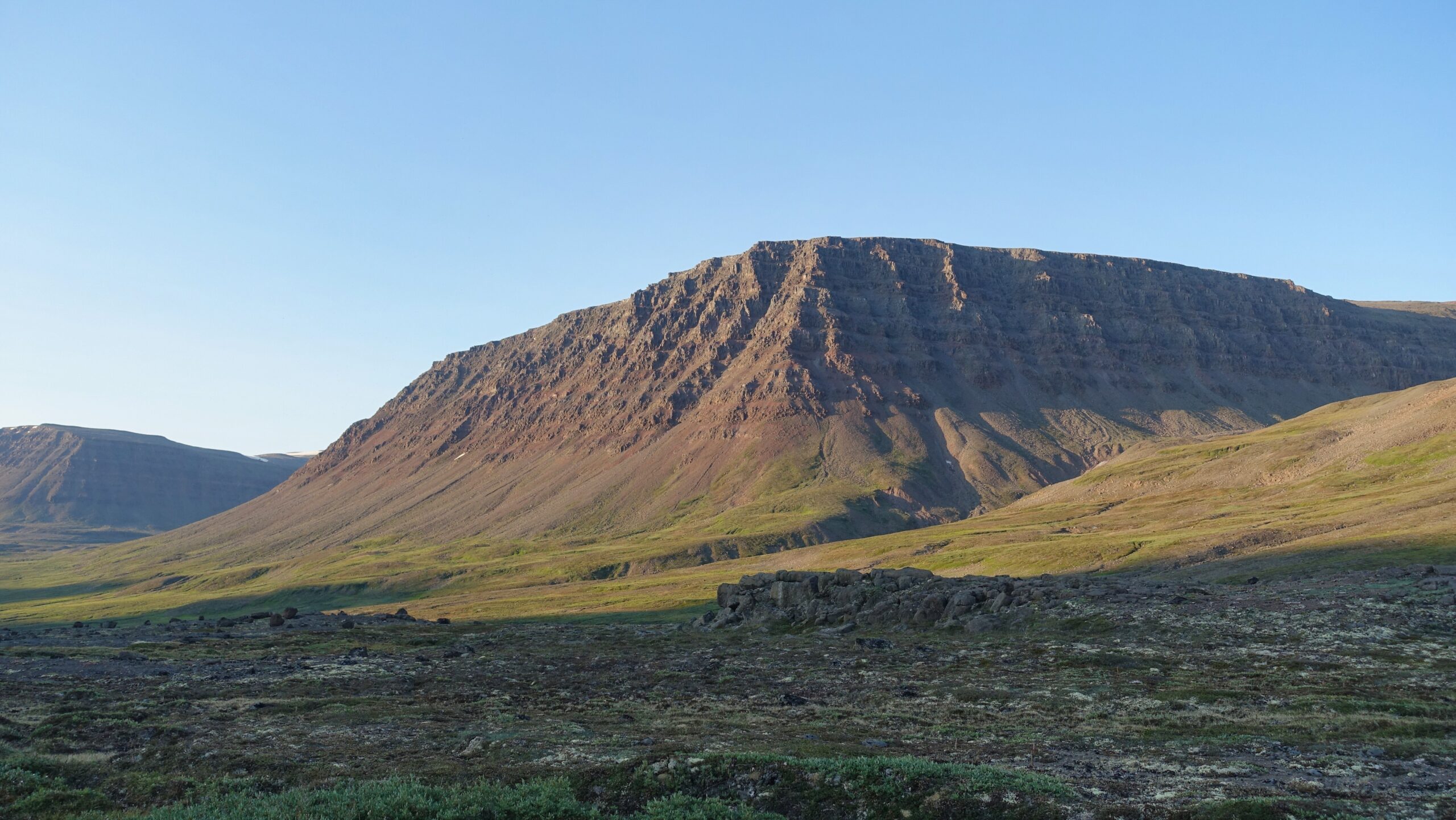
360 degrees of midnight lighting from my camp
The relative scarcity of water is something I was not expecting. I frequently passed signs of heavy run-off – deep channels carved into earth where it was clear large volumes of water frequently flowed. Almost all of them were dry, or nearly dry though. A likely possibility was that these were seasonal channels. The snowpack had melted for the summer, and the channels dried up afterwards. Regardless, it may have been for the better. The ground was extremely spongy, and likely would have been a very boggy and unpleasant experience with more water around.
I slept well; surprisingly well. Unusually, I struggled to get myself moving in the morning. Seeing the masses of mosquitos covering my tent certainly didn’t help my motivation, and I spent a good chunk of the morning reading in the tent.
Eventually I dragged myself out. I was feeling better, but still sluggish. The plan I had loosely formulated the previous night was that I would leave my camp and hike out to the pass where I had initially planned to camp before returning, breaking camp, and heading back for town. After spending much of the morning in my tent, the plan was revised to hiking back to town via Kuannit – cool volcanic rock formations on the southern coast.
I stayed high on the valley as I started south, making for a steep and sometimes troublesome route. This proved to be a good choice though. As I approached the head of the valley, I decided to ascend the table mountain from this direction. My instincts proved correct as before long I found some cairns indicating a semi-marked route up. Several false-tops later, and I reached the flat, open expanse of the summit. Hoping for expansive views north up the valley, I pushed on. And wow, was I rewarded.
After fearing that I would have ages of time and a long wait in town, I suddenly had too much to do. It was really cool exploring the flat moonscape of volcanic rock and glacier at the top. On the ascent, I had given myself a hard turnaround time of 14:30 (didn’t want to put myself at any risk of missing my boat home) and that was approaching more rapidly than I wanted. I could have happily spent several more hours exploring, but the ferry dock was about two hours away and an overnight pack made running an extremely unattractive option.
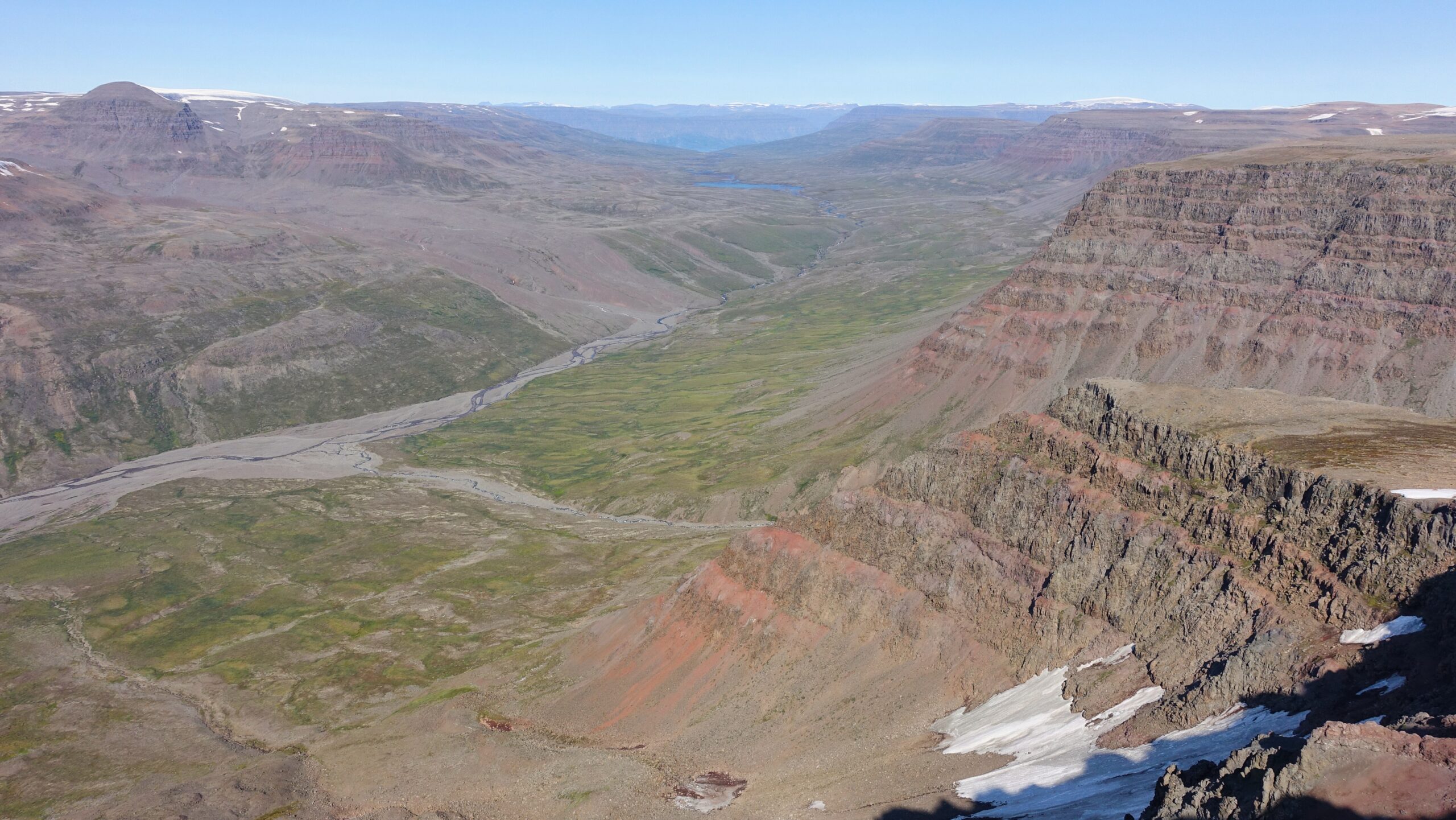
Grand views of Blæsedalen from Innarsuaq
I made good time on the descent. The apathy and fatigue of the last 24hours had largely vanished, but now I had to constantly have one eye on the clock.
Arguably Disko’s star attraction is the volcanic formations of Kuannit – dramatic black rock formations on the sea cliffs. As I descended, I could see a hiking group below me making their way out and then back from the formations. They had been something of an afterthought for me, but now that I was in the immediate area, I couldn’t help but try to justify the addition. By this point, I was short on time and I wasn’t able to properly explore the area, but I had just enough time to get the idea.
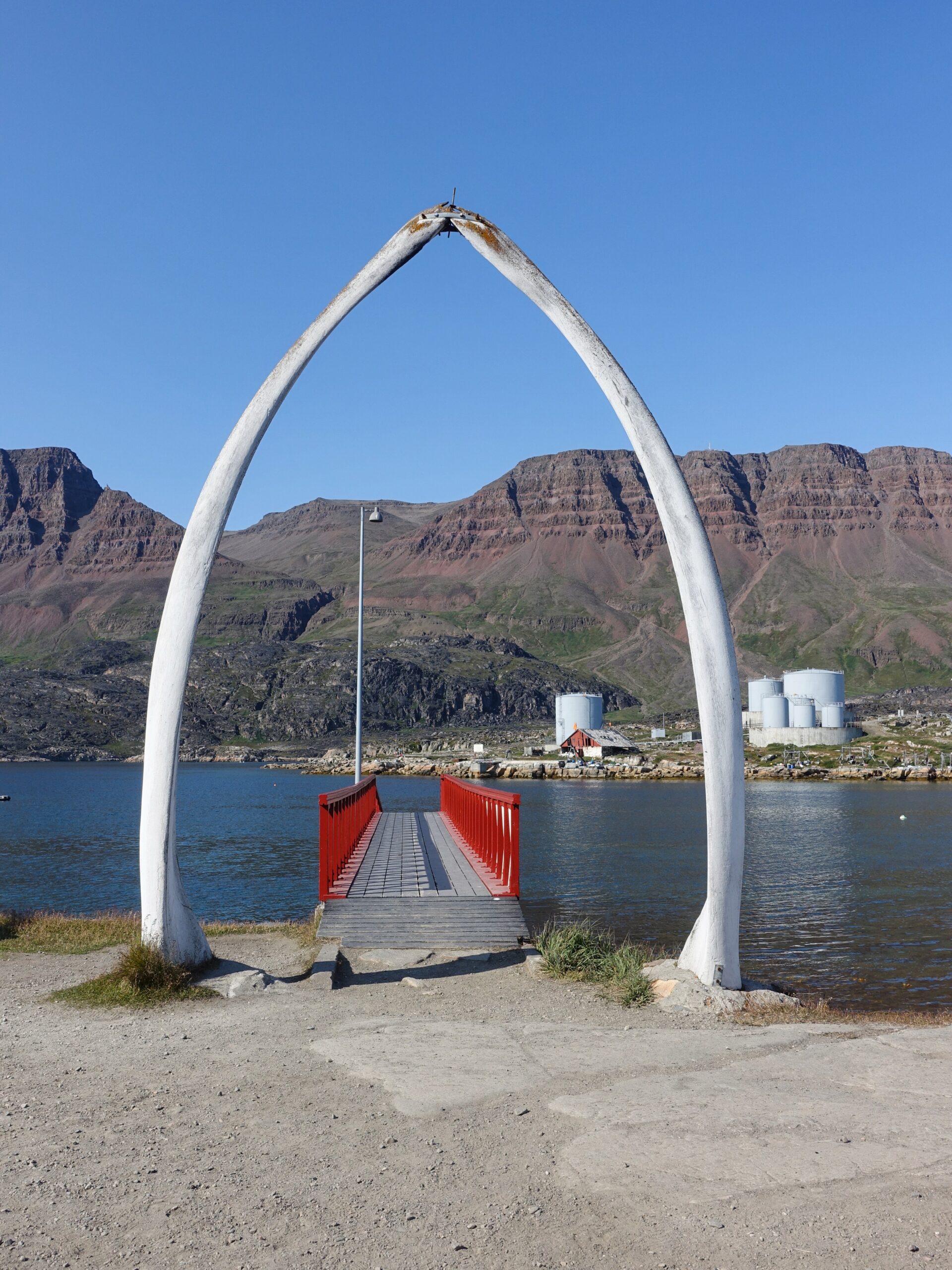
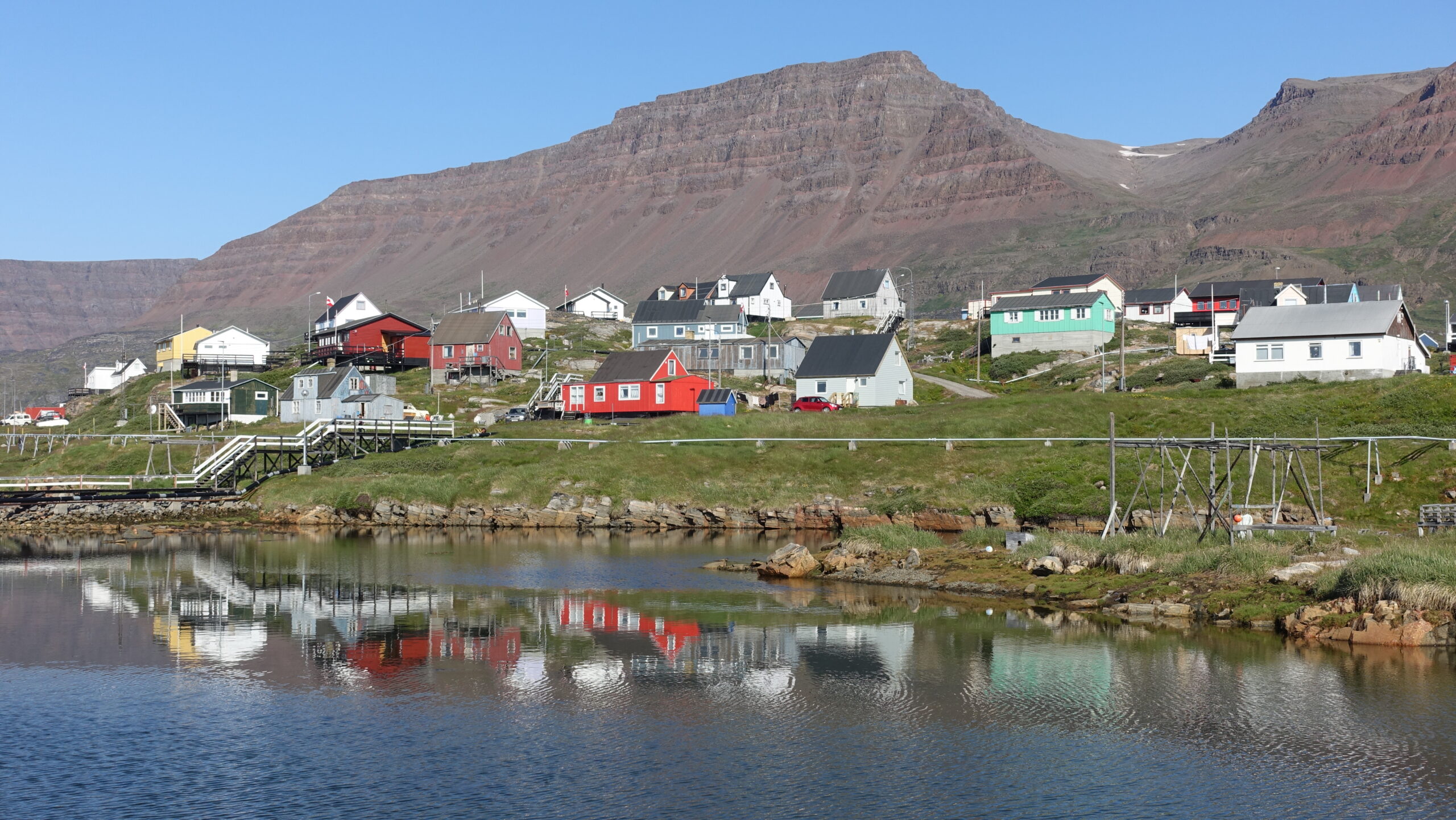
I timed my return well, arriving about 20 minutes before the 30 minutes I was supposed to arrive in advance of the ferry departure. The ferry had been taken out on a charter fishing trip and arrived back very late though, so I ended up waiting quite a while. The delay definitely caused some anxiety (I had no means of communication or internet access), though given that it was a fully booked ferry, there were seven other people also clearly waiting for the same boat. I could have spent that extra time exploring town a bit more – I obviously did not want to leave the dock though. The ferry could arrive at any time and would not wait for me.
The ferry is just that: a ferry, not a sightseeing excursion and it typically zips straight out and back as quickly and directly as possible. Maybe they were feeling bad for tardiness, but they took us on the scenic route home – staying closer to the coast and weaving through the icebergs more than they had to. The conditions were pristine, but the water was noticeably choppier than the outbound trip. The little boat lacked the displacement to make any real impression on the chop, so we would frequently bounce off the top, landing with a very noticeable drop.
I have mixed feelings about the reduced timeline for Disko. I would have liked to do the full circuit as initially intended. Three days would have been an aggressive timeline though, and I’m far from convinced that the scenery would have changed significantly over the course of the hike. The mosquitos really were a nuisance that I had not expected and was unprepared for. At the time I was feeling very ‘right’ about the decision. My biggest regret is that I was just feeling abnormally lethargic on the day. That happens sometimes, and is just the way it is, but I really hope it does not become a pattern for future trips.
It seems strange to complain about perfectly clear skies, but much like the other North Atlantic islands, Greenland just doesn’t quite look right under direct sunlight. Not only do some moody clouds just fit the atmosphere better, but they make the colours pop.
The Icefront
Tuesday, 29 July
The tourist excursion I was very keen to do here was to take a midnight boat out to the icefront. A highlight of my Svalbard trip was taking a boat trip to Barentsburg (too early to land in Pyramidn due to sea ice), so I had high hopes that it would be a good investment as long as I could book a day with nice weather. Plus I definitely regretted not doing any boat excursions in Nuuk… The goal was to see things not possible from shore, and ideally see some of the particularly interesting shapes the bergs melt into.
Tuesday made the most sense of the remaining two evenings. But the long-standing forecast was for fog all day so I was hesitant to commit. Those forecasts had long proved unreliable in Greenland, and sure enough, I woke to clear skies and good visibility. I booked onto an evening boat.
As we cruised along the icefront, there were many waterfalls in the ice and a few small calving events. The front of the icefjord is dominated by the largest chunks of ice – up to cubic kilometers in size. They are trapped on the floor of the fjord, holding the rest of the ice behind them at bay until they are broken up by force and someone else takes their place. It often felt more like seeing a large glacier than a collection of icebergs. About halfway across the mouth of the fjord we spotted a pod (at least five) of humpback whales feeding and stopped.
I was a little disappointed, as once we had observed the whales for a time, they weren’t doing anything different. I was very happy to have seen them, but could see potentially interesting ice formations ahead. I was on a boat to see the icebergs, not a whale watching cruise, after all. And my camera lacked the zoom for wildlife photography.
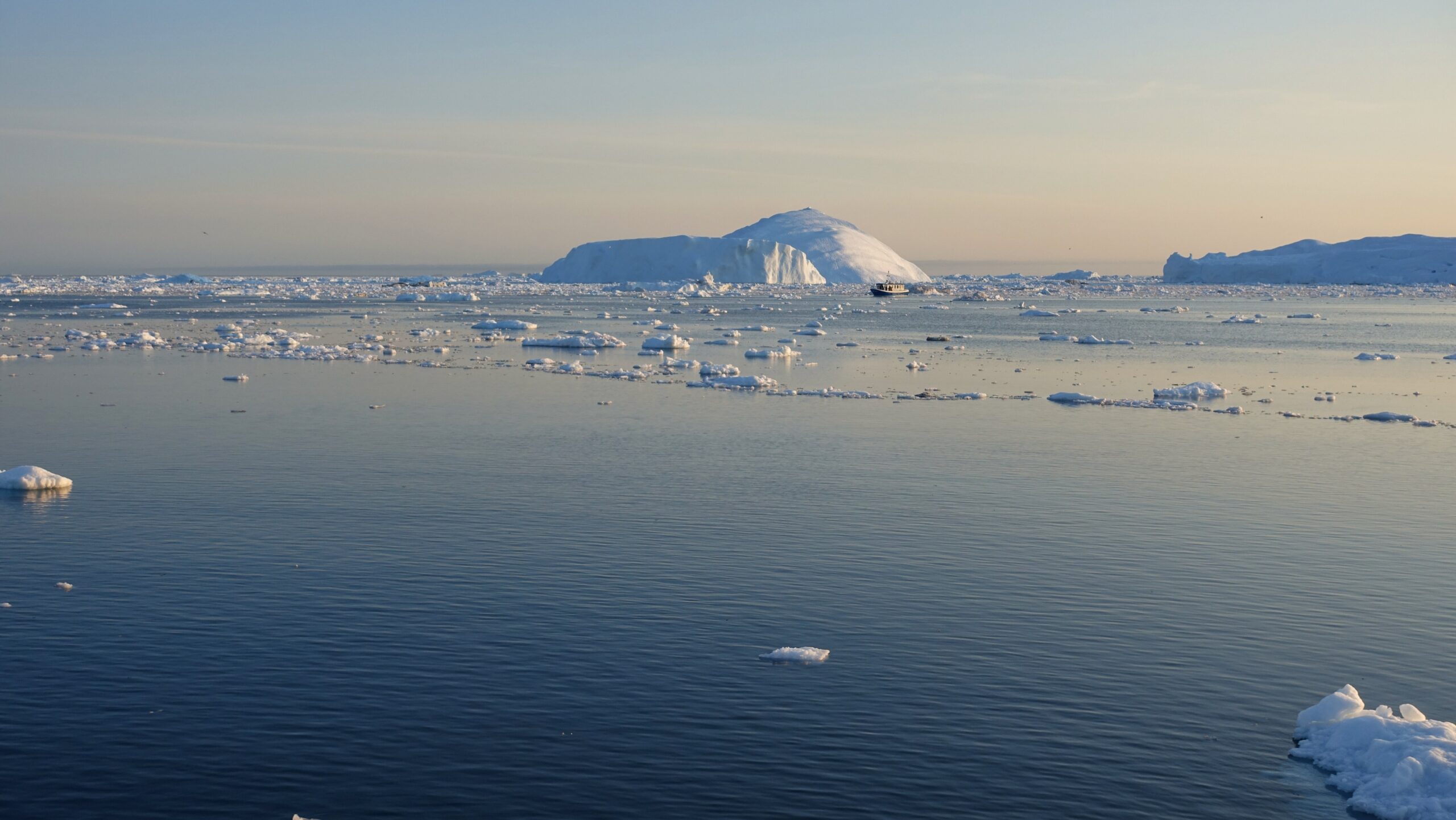
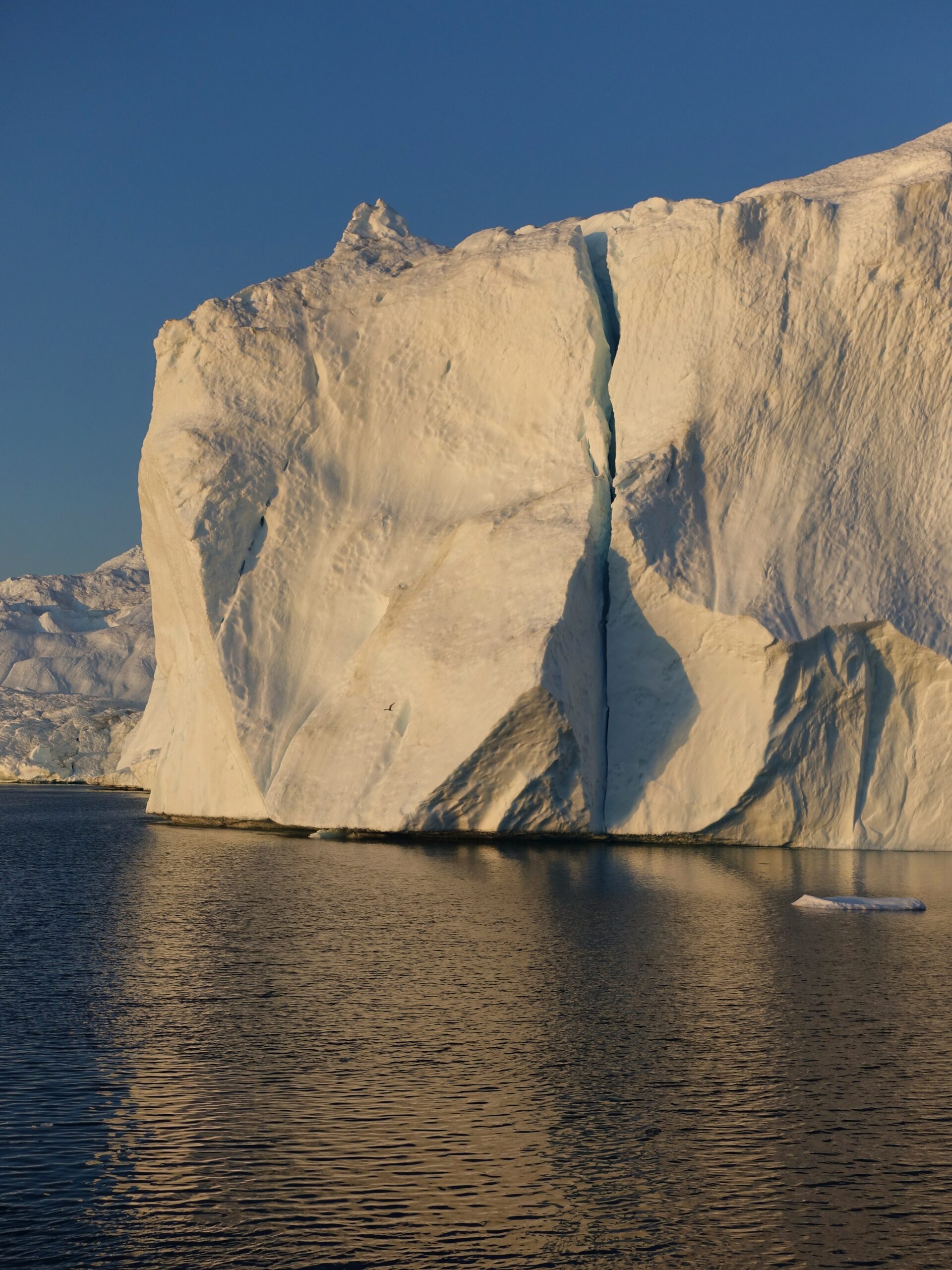
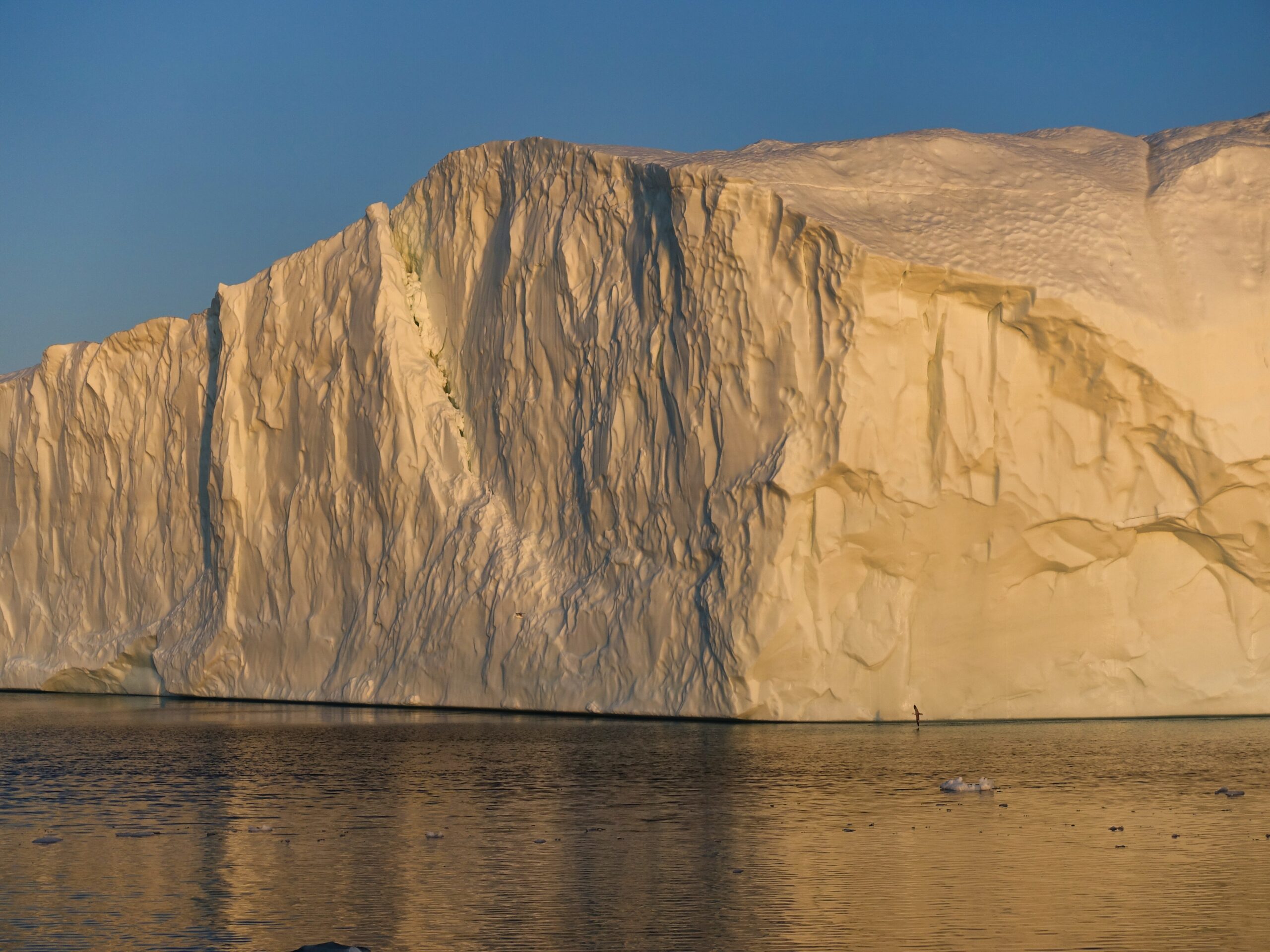
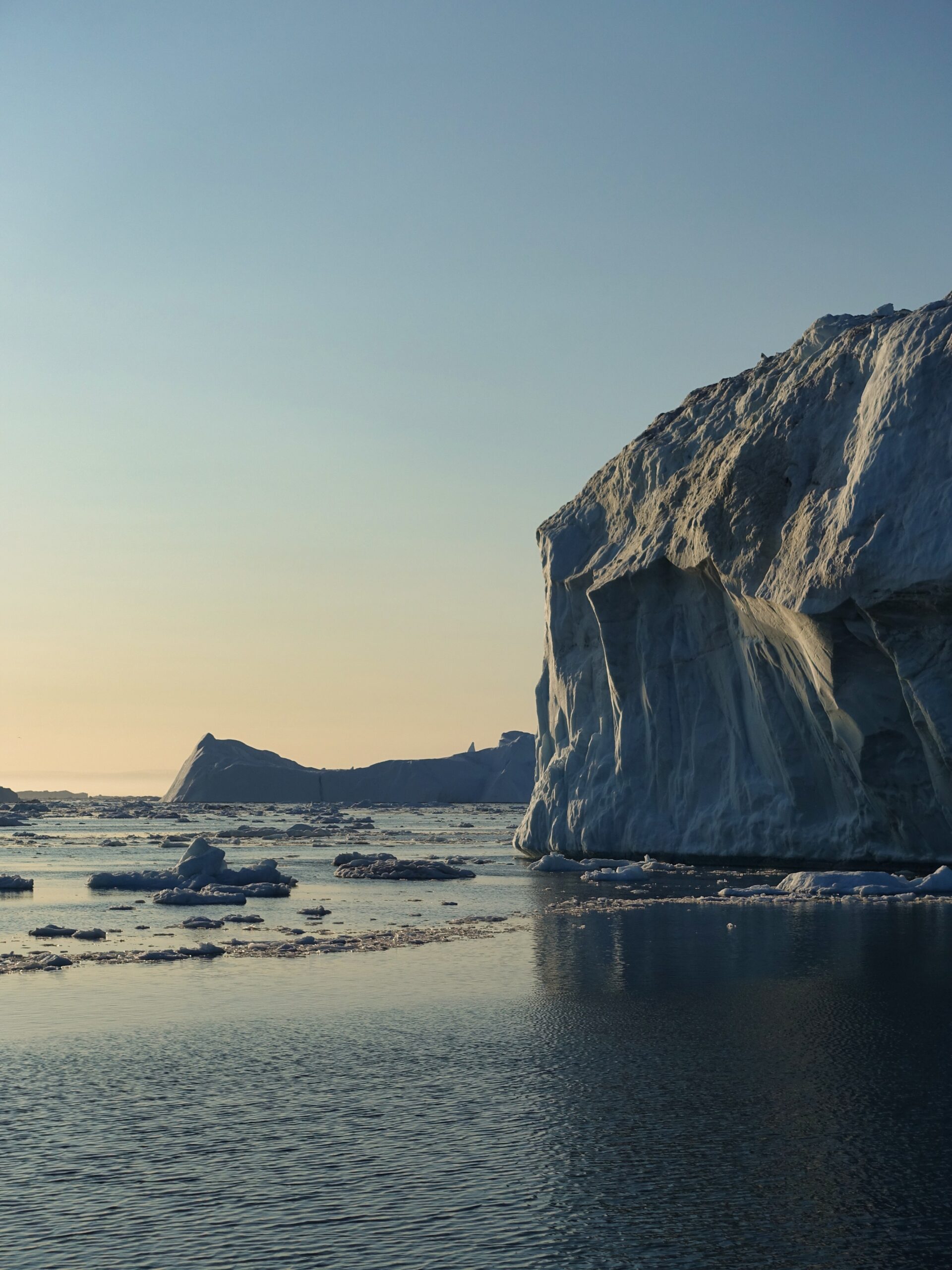
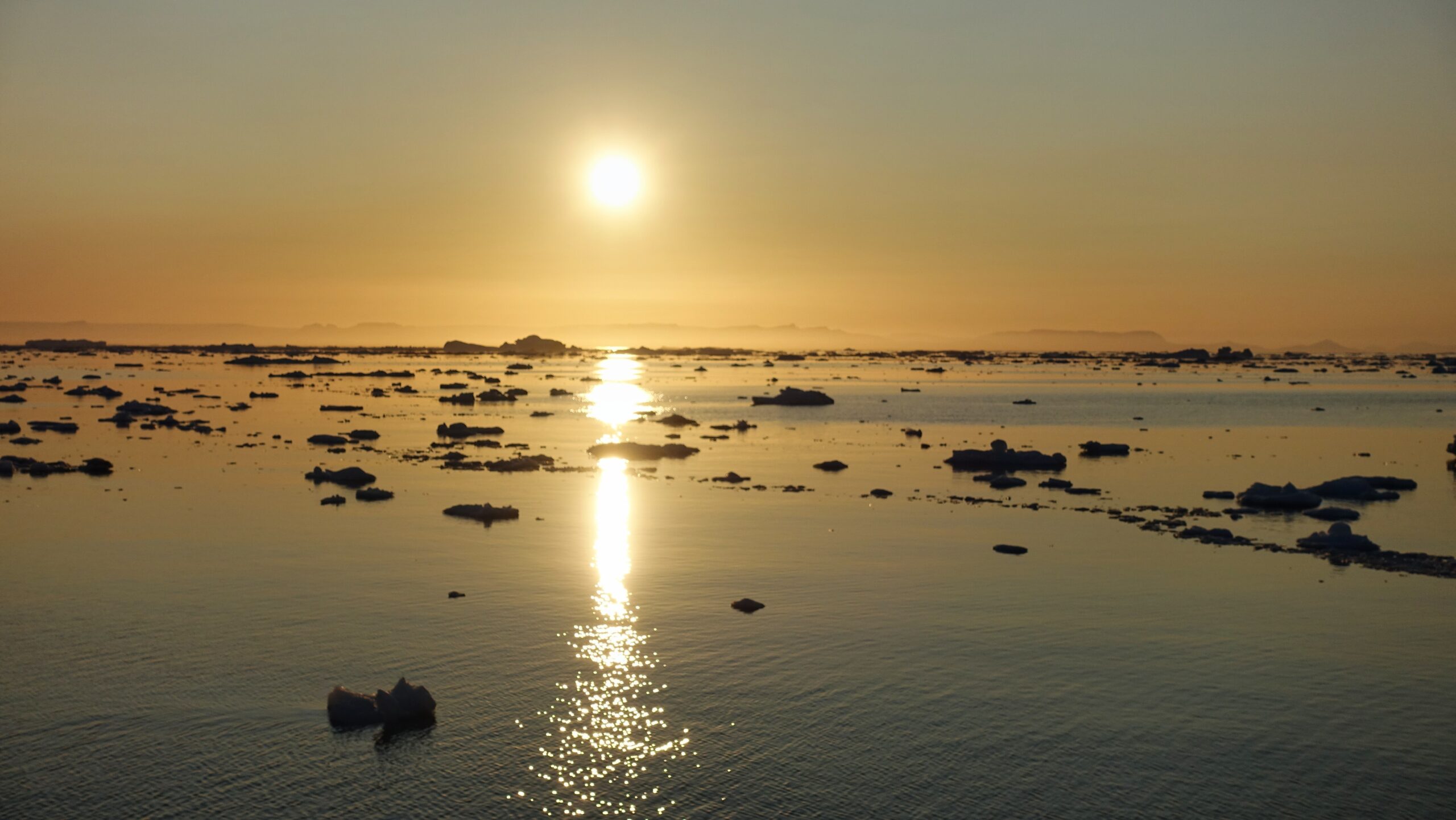
Midnight on the icefront
Overall, I’m not completely sure how I feel about the boat. It was a cool experience, made a little more special by the whales. But it didn’t really give me much of a different perspective from what I had already seen from shore. I know (and saw on my way back from Disko) that icebergs often melt into very cool shapes – arches, hoops, pillars, etc. I was really hoping to see more of these. Thinking about it, it is logical that the ice would not yet have had the chance to melt though. And what the Bay delivers changes on a daily basis too.
Oqaatsut
Wednesday, 30 July
A nice Greenlandic dinner was planned for the final full day in the North. That impacted planning, but given the unexpectedly favourable weather, I had fully accomplished all of my goals.
The remaining option was Oqaatsut, a tiny settlement, roughly 20km north of Ilulissat. I was interested in seeing the settlement, but was apathetic about the hiking route, particularly given the 40km round-trip distance. It had therefore been relegated to a backup hike.
I started out in midmorning, too late to realistically reach the settlement before the hard turnaround time determined by the dinner reservation. I figured I would go as far as I felt like. The hike routes via the airport and when I reached it, I realised that I had a problem. I arrived at a road leading to an active construction zone for the new airport, with signs mandating PPE and stating ‘blast zone’ – it did not seem like a place I was supposed to be… Given that I was already on the fence about the hike, I opted to just turn around.
I would see the route from the air the next day on the flight out. If I could have gotten beyond the airport construction works, it looked a more interesting day than I had given it credit. I somewhat regretted not persevering. I know I probably made the right decision though – walking several kilometers each direction in an active construction zone is neither the most fun nor safe thing to do, whether I am supposed to be there or not.
The dinner was excellent, though it was heavily overshadowed by ominous flight updates from Air Greenland. I may not have gotten my yak steak in Khumbu, but I was sure to try musk ox given the opportunity!
Departure
Thursday, 31 July – Saturday, 2 August
The theme of flight difficulties would continue on the outbound journey. The plan was to fly to Nuuk via Air Greenland on Thursday afternoon before onward flights home via Keflavik with Iceland Air on Friday evening (and continuing on Saturday morning). Things did not go to plan, or at least they did not go smoothly.
Less than 24 hours to departure from Ilulissat, we were informed that the flight to Nuuk was cancelled and we were rebooked on a later flight the same day. Frustrating, and concerning given the airline’s record, but perfectly workable. Later that evening, however, I received another email stating that the rebooked flight was also cancelled and we were now departing nearly 30 hours late. This would create significant problems for the international with Iceland Air and the next option was several days later, Monday evening. The morning of departure, I managed to get the airline to provide a workable solution by splitting us between two flights (flights that we could only hope would actually operate).
With the new airport imminent, the current airport will transport you back to a simpler time. Not only does the entire airport sport a delightfully retro paint scheme, but the terminal is a single room. There is no security checkpoint whatsoever, not even a mall cop. Passengers are able to walk in the entrance and directly access the apron. All afternoon there was a young boy ‘shooting’ a toy rifle right in front of the gate – not something you see every day…
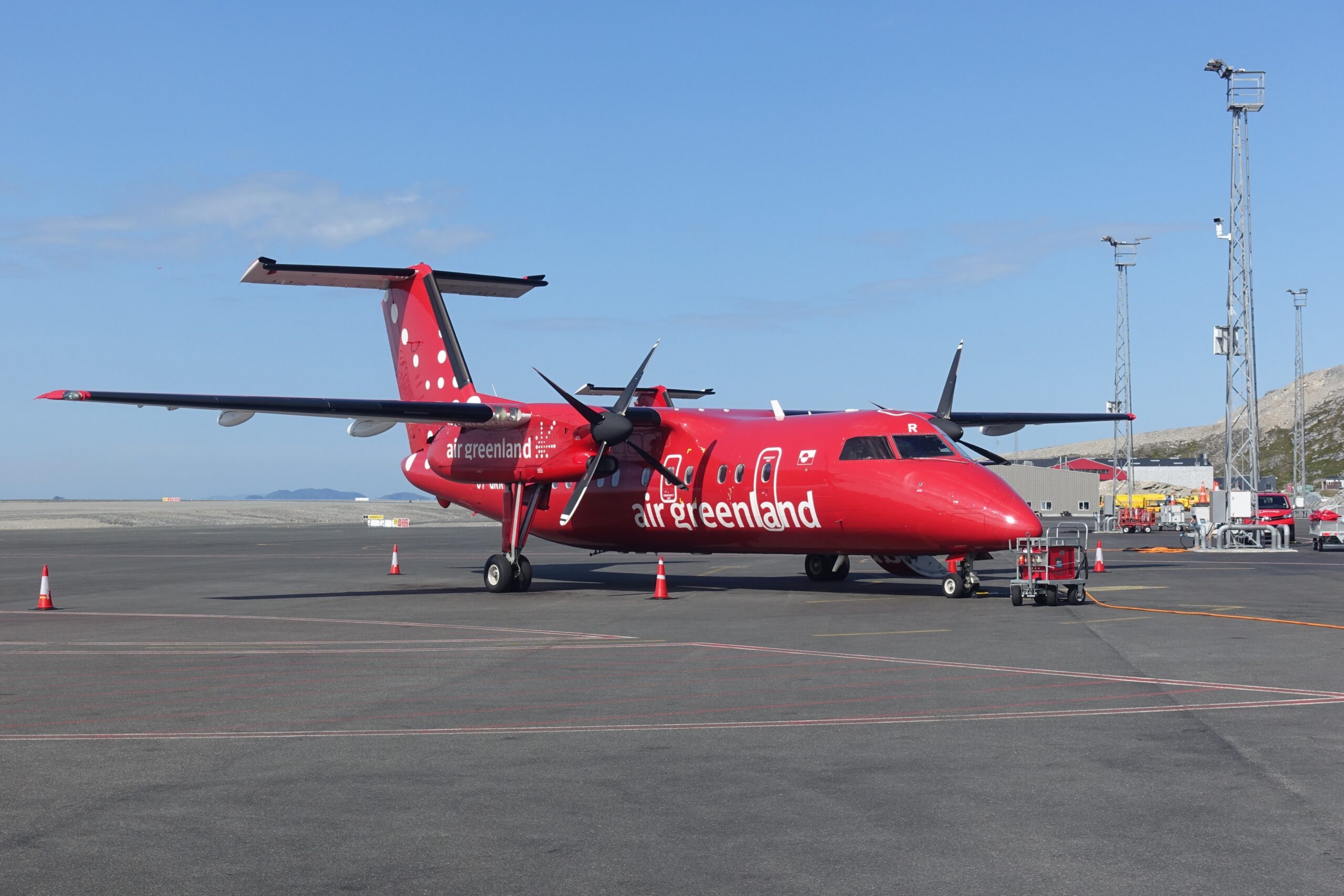
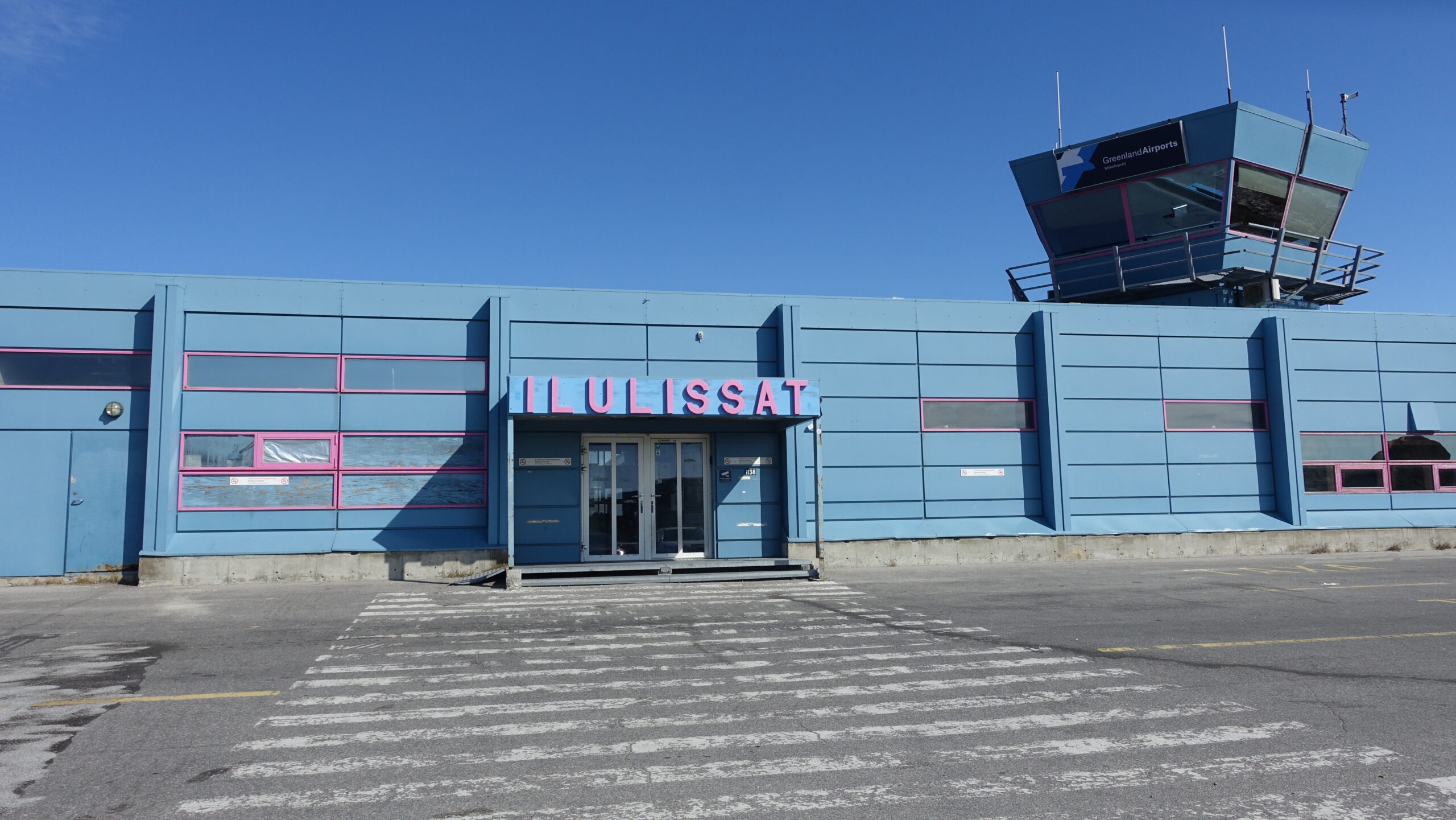
A bold colour scheme. Am I in Vice City?
After a stressful day worrying about whether Air Greenland would decide to fly the third round of rebook flights, we had both finally made it back to Nuuk.
Fortunately, the outbound international flights went smoothly. It required an overnight in Keflavik, something that is never fun, but it was the only option. Importantly, both flights operated on time. NS was there to pick up the slack on arrival in NL though – you can always count on them to supply a delay!
Afterwards
As with Nuuk, there were a handful of things I could have done but chose not to. This time, was far more content with my decisions though. Ilulissat is something of a hub for [exceedingly expensive] excursions. Qeqertarsuaq not withstanding, the primary one I would have been interested in was an all-day boat trip to Eqip Sermia, the calving glacier front north of Ilulissat. When I first saw write-ups for this (published prior to the intended 2020 trip), prices were very reasonable. Even in 2020, they had swelled to the point where I just couldn’t reasonably consider it though. I have seen big glaciers before, and will again. I also could have hiked to Sermeq Avannarleq, the inland icecap. This was described as a ‘very boggy’ one-week trek on my map and the landscape struck me as uninspiring – it was quickly eliminated during planning.
There were quite a few seemingly needless issues on this leg of the trip. From the continuous and inexplicable flight problems to the AirBnB concerns. They definitely took their toll. Greenland is a remote corner of the world, and that would be a very justifiable explanation for travel challenges. Unfortunately, the issues instead seemed to stem from people inexplicably getting the basics wrong.
Despite the difficulties, it was an excellent trip. The timeline was just about perfect. Despite the missed opportunities, particularly in Nuuk, I can feel like I have ‘completed’ West Greenland. I still hope to return to see the other regions. Mountaineering in remote East Greenland has particular appeal and is definitely within reach (mainly a financial limiter). I found an expedition to climb unnamed tops around Kulusuk that looks incredible. Being with an expedition would also likely eliminate a lot of the problems that were encountered on this trip.
Footnote
All photos are exclusive property and may not be copied, downloaded, reproduced, manipulated or used in any way without permission of the photographer.
Favourite Stories